Taj Magazine’s 50th Anniversary issue
They sent me to Bekal to write about the Jiva spa there
Click here for PDF
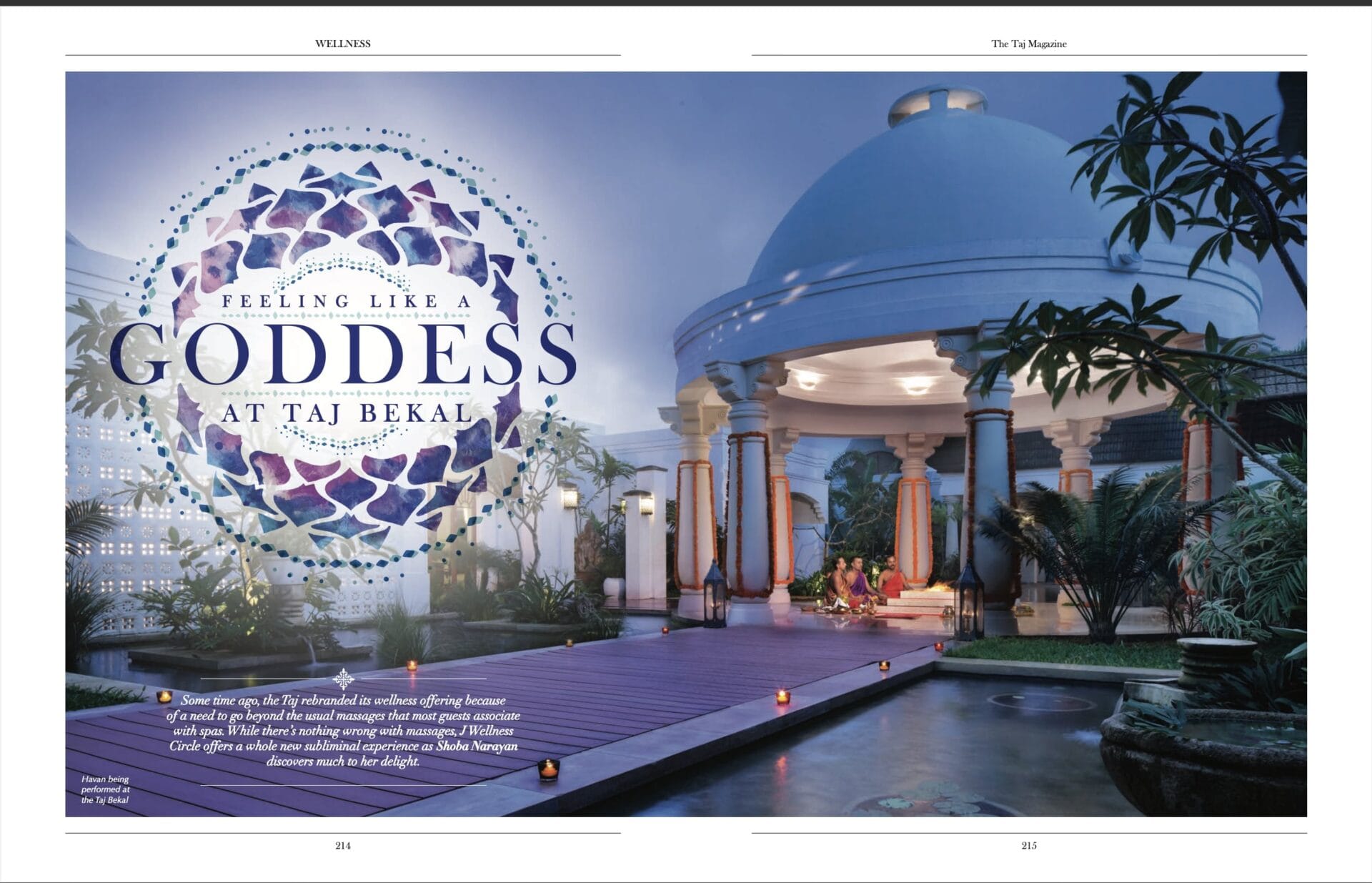

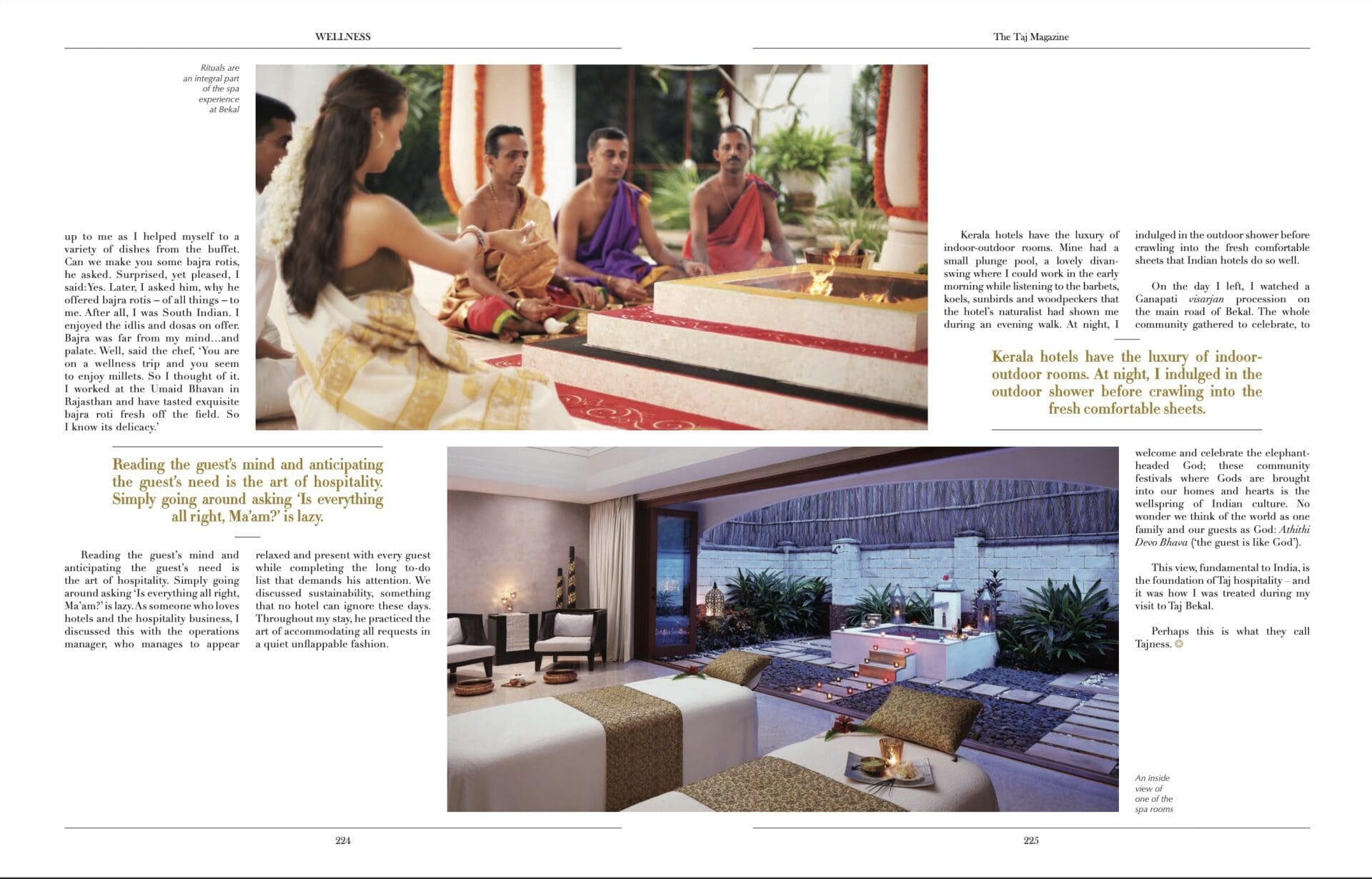
To have milk and panchamrita poured over your body is profoundly moving– because it is how we Indians worship our Gods. We welcome them into our homes with garlands and song, pamper them with food and drink, and do abhisheka (ritual bath) and archana (singing their praises) for them. This was what I was experiencing at the J Wellness Circle at the Taj Bekal.
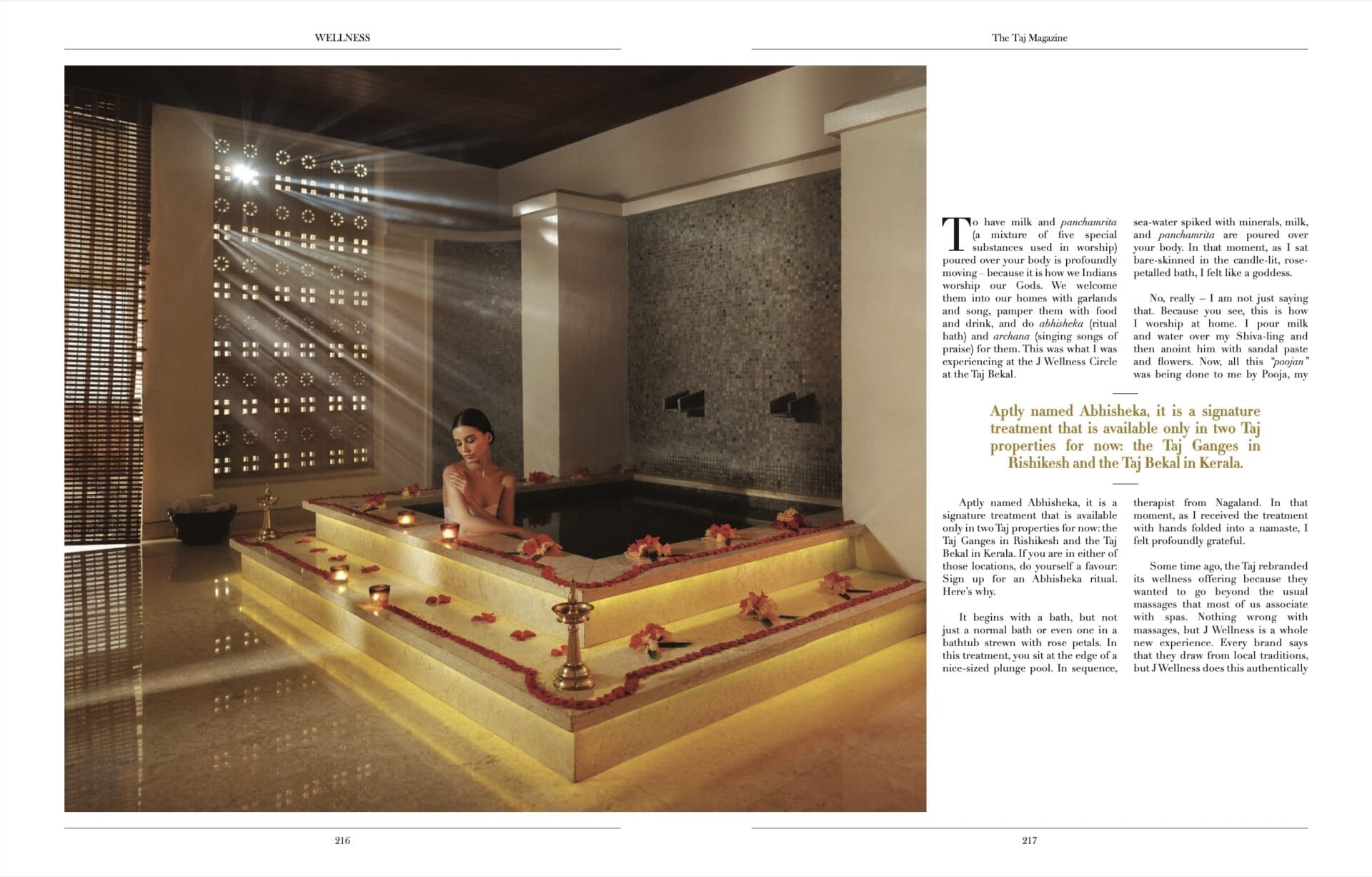
Aptly named Abhisheka, it is a signature treatment that is available only in two Taj properties for now: the Taj Ganges in Rishikesh and the Taj Bekal in Kerala. If you are in either of those locations, do yourself a favour. Sign up for an abhisheka ritual. Here’s why.
It begins with a bath, but not just a normal bath or even one in a bathtub strewn with rose petals. In this treatment, you sit at the edge of a nice-sized plunge pool. In sequence, sea-water spiked with minerals, milk, and panchamrita are poured over your body. In that moment, as I sat bare-skinned in the candle-lit, rose-petalled bath, I felt like a goddess.
No really– I am not just saying that. Because you see, this is how I worship at home. I pour milk and water over my Shiva-ling and then anoint him with sandal paste and flowers. Now, all this “poojan” was being done to me by Pooja, my therapist from Nagaland. In that moment, as I received the treatment with hands folded into a namaste, I felt profoundly grateful.
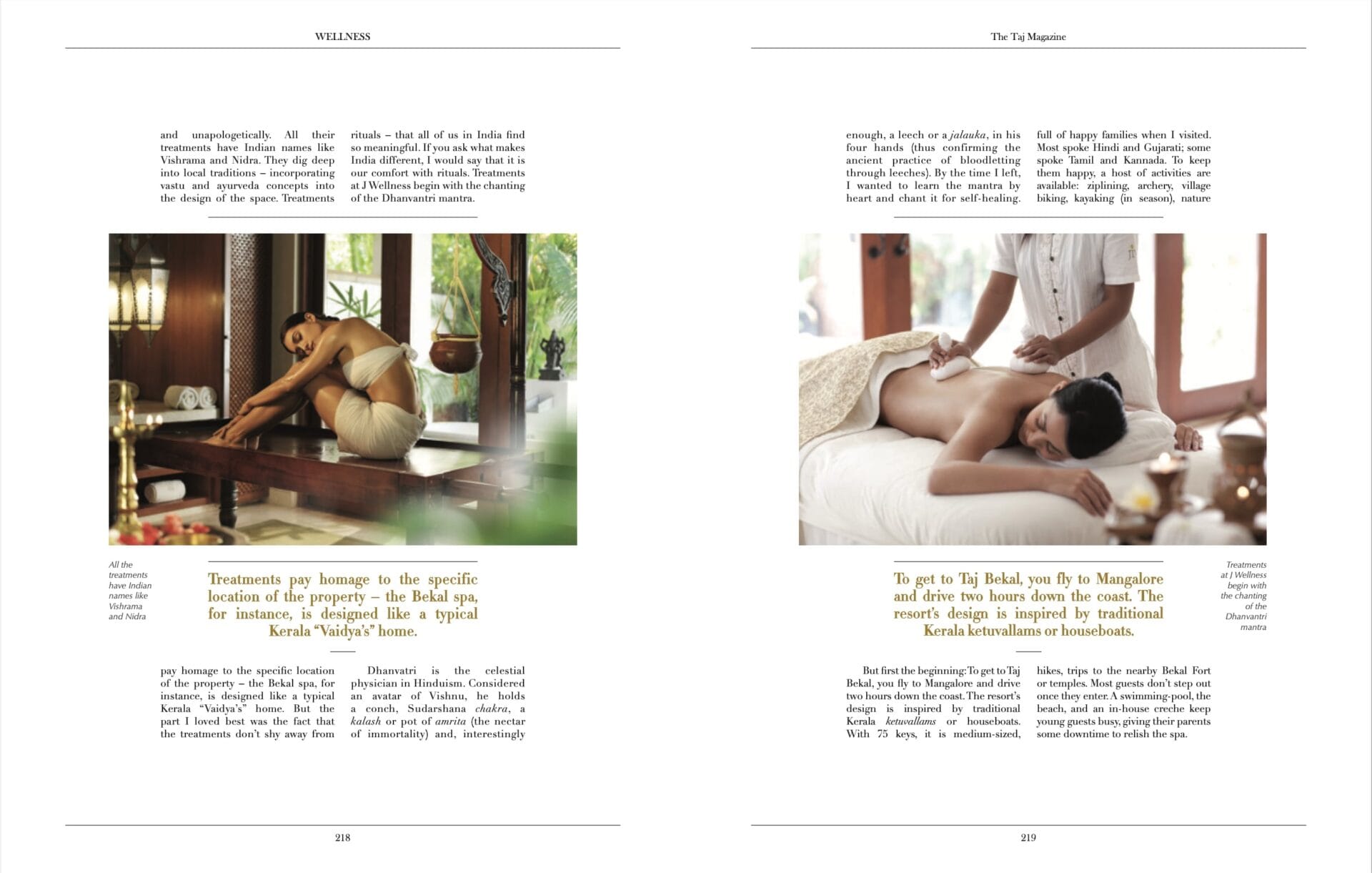
Some time ago, the Taj rebranded its wellness offering. The reason, said Sushmita Sarangi who heads the vertical, was because they wanted to go beyond the usual massages that most of us associate with spas. Nothing wrong with massages, but J Wellness is a whole new ballgame. Every brand says that they draw from local traditions, but J Wellness does this authentically and unapologetically. Their treatments all have Indian names like Vishrama and Nidra. They dig deep into local traditions– incorporating vasthu and ayurveda concepts into the design of the space. Treatments pay homage to the specific location of the property– the Bekal spa, for instance, is designed like a typical Kerala “Vaidya’s” home. But the part I loved best was the fact that the treatments don’t shy away from rituals– that all of us in India find so meaningful. If you ask what makes India different, I would say that it is our comfort with rituals. Treatments at J Wellness begin with the chanting of the Dhanvantri mantra.
Dhanvatri is the celestial physician in Hinduism. Considered an avatar of Vishnu, he holds a conch, sudarshana chakra, a kalash or pot of amrita (the nectar of immortality) and, interestingly enough, a leech or a jalauka, in his four hands (thus confirming the ancient practice of bloodletting through leeches). By the time I left, I wanted to learn the mantra by heart and chant it for self-healing.
But first the beginning. To get to the Taj Bekal, you fly to Mangalore and drive two hours down the coast. The resort’s design is inspired by traditional Kerala ketuvallams or houseboats. With 75 keys, it is medium-sized, full of happy families when I visited. Most spoke Hindi and Gujarati; some spoke Tamil and Kannada. To keep them happy, a host of activities are available: ziplining, archery, village biking, kayaking (in season), nature hikes, trips to the nearby Bekal Fort or temples. Most guests don’t step out once they enter. A swimming-pool, the beach, and a creche in-house keeps young guests busy, giving their parents some downtime to relish the spa.
Rebranding the spa has yielded guests serious about wellness, said Dr. Ravishankar Bhat, the wellness manager. Many guests come for as long as a month. The minute they arrive, an in-house Whatsapp group is formed. It includes spa therapists, doctors, chefs and service staff to ensure seamless communication about the patient. For instance, the doctor tells the chefs what to prepare for each meal– mostly sattvic food, served in the room so that guests don’t get tempted by the buffet spread on offer. A large part of Dr. Bhat’s job involves motivating and keeping guests on track for their wellness journey. This is not easy. “They come with knee pain for treatment and on Day 2, they want to join the village cycling tour,” he says. “I have to tell them No. They need to rest their knees.”
The treatment protocol is decided by Dr. Mithu, the ayurvedic physician after an extensive intake consultation. Once he learned my diet and routine, he gave me certain simple tips that I could incorporate in my life: like drinking one litre of water first thing in the morning. When I complained of sleeplessness, Dr. Mithu prescribed the shirodara—a deeply relaxing treatment in which warm oil is poured on your forehead for a good 30 minutes. After the shirodara, I enjoyed an Abhyanga or oil massage, expertly done by Rojina and Premeshwari, both from Manipur. Most of the therapists have been trained in-house at the Jiva Academy in Bangalore. After three months of training, the therapists are sent to different Taj properties all over India.
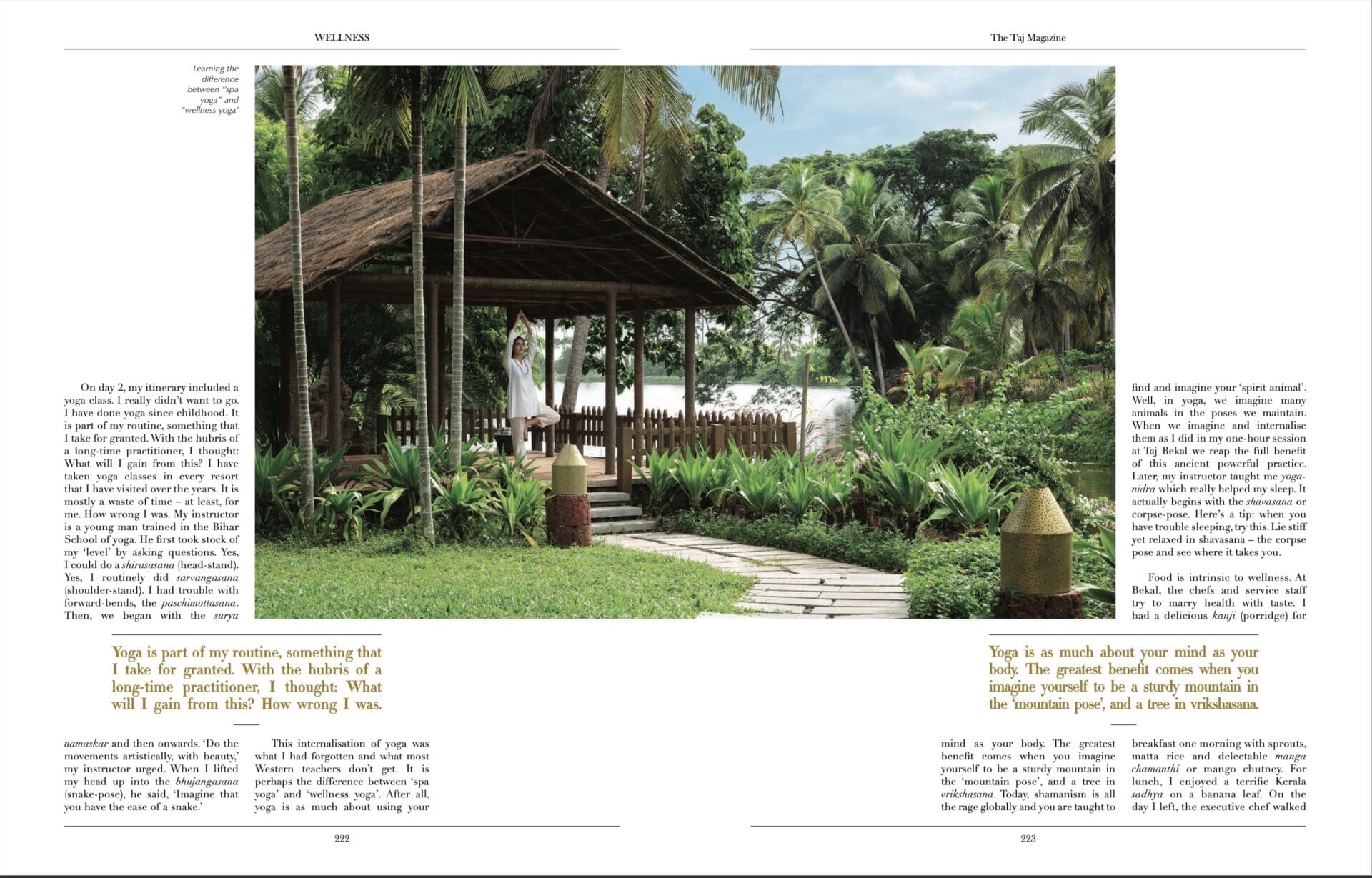
On day 2, my itinerary included a yoga class. I really didn’t want to go. I have done yoga since childhood. It is part of my routine, something that I take for granted. With the hubris of a long time practitioner, I thought—what will I gain from this? I have taken yoga classes in every resort that I have visited—the Aman, Oberoi, ITC, and more. It is mostly a waste of time– for me. How wrong I was. Sudeep, my instructor, is a young man trained in the Bihar School of yoga. He first took stock of my “level” by asking questions. Yes, I could do a shirasasana (head-stand). Yes, I routinely did sarvangasana (shoulder-stand). I had trouble with forward-bends—paschimottasana. Then, we began. The surya namaskar at first and then onwards. “Do the movements artistically, with beauty,” Sudeep urged. When I lifted my head up into the bhujangasana (snake-pose), he said, “Imagine that you have the ease of a snake.”
This internalisation of yoga was what I had forgotten and what most Western teachers don’t get. It is perhaps the difference between “spa yoga” and “wellness yoga.” After all, yoga is as much about using your mind as your body. The greatest benefit comes when you imagine yourself to be a sturdy mountain in the “mountain pose,” and a tree in vrikshasana. Today, shamanism is all the rage globally and you are taught to find and imagine your “spirit animal.” Well, in yoga, we imagine many animals in the poses. When we imagine and internalise them as I did in my one-hour session with Sudeep, we reap the full benefit of this ancient powerful practice. Later, Sudeep taught me yoga-nidra which really helped my sleep. It actually begins with the shavasana or corpse-pose. Here’s a tip: when you have trouble sleeping, try this. Lie stiff yet relaxed in shavasana– the corpse pose and see where it takes you.
Food is intrinsic to wellness. At Bekal, the chefs and service staff try to marry health with taste. I had a delicious kanji (porridge) for breakfast one morning with sprouts, matta rice and a delicious manga chamanthi or mango chutney. I enjoyed a terrific Kerala sadhya on a banana leaf and wondered why the people in the next table had bought packed theplas that they were serving to their children. On the day I left, executive chef Anbalagan walked up to me as I helped myself to a variety of dishes from the buffet. Can we make you some bajra rotis, he asked. Surprised, yet pleased, I said Yes. Later, I asked him, why he offered bajra rotis– of all things– to me. After all, I was South Indian. I enjoyed the idlis and dosas on offer. Bajra was far from my mind…and palate. Well, said the chef, “You are on a wellness trip and you seem to enjoy millets. So I thought of it. I worked at the Umaid Bhavan in Rajasthan and have tasted exquisite bajra roti fresh off the field. So I know its delicacy.”
Reading the guest’s mind, anticipating the guest’s need is the art of hospitality. Simply going around asking “Is everything all right, Ma’am?” is lazy. As someone who loves hotels and the hospitality business, I discussed this with operations manager, Shiju Nambiar, who manages to appear relaxed and present with every guest while completing the long to-do list that demands his attention. We discussed sustainability, something that no hotel can ignore these days. Throughout my stay, Nambiar practiced the art of accommodating all requests in a quiet unflappable fashion.
Kerala hotels have the luxury of indoor-outdoor rooms. Mine had a small plunge pool, a lovely divan-swing where I could work in the early morning while listening to the barbets, koels, sunbirds and woodpeckers that naturalist Amal had shown me during an evening walk. At night, I indulged in the outdoor shower before crawling into the fresh comfortable sheets that Indian hotels do so well.
On the day I left, I watched a Ganapati visarjan procession on the main road of Bekal. The whole community gathered to celebrate, to welcome and celebrate the elephant-headed God. These communal festivals where Gods are brought into our homes and hearts is the wellspring of Indian culture. No wonder we think of the world as one family and our guests as God. “Athithi Devo Bhava (the guest is like God).”
This view, fundamental to India, is the foundation of Taj hospitality– and it was how I was treated during my visit to Taj Bekal.
Perhaps this is what they call Tajness.



Leave A Comment