
August 9 2025
Ajanta Ellora Dhyaana Farms Aurangabad
Embracing the slow life in Aurangabad
How luxury farmstays and bespoke dining experiences are transforming this ancient land, home to the Ajanta and Ellora caves which go back to the the 2nd century BCE
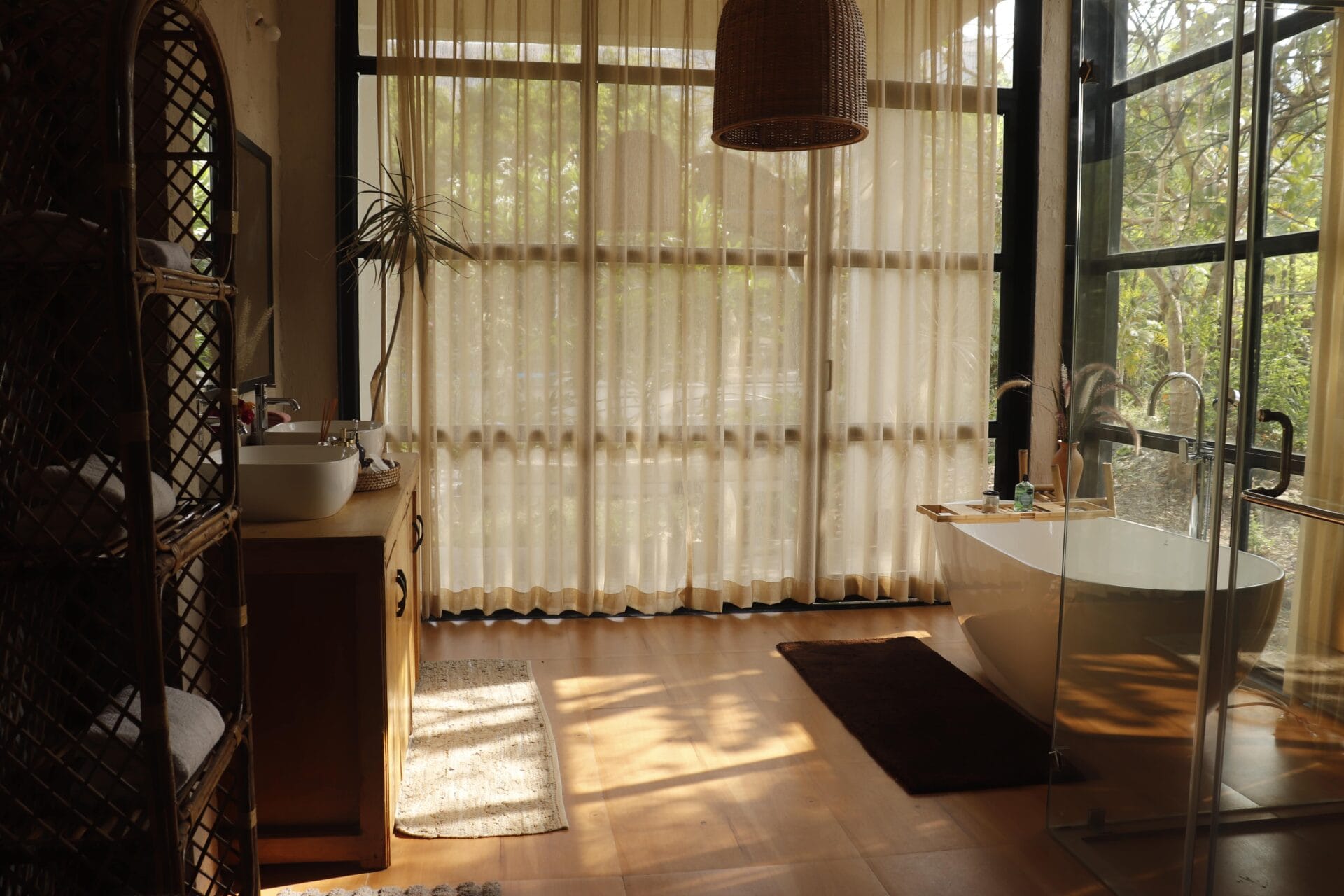
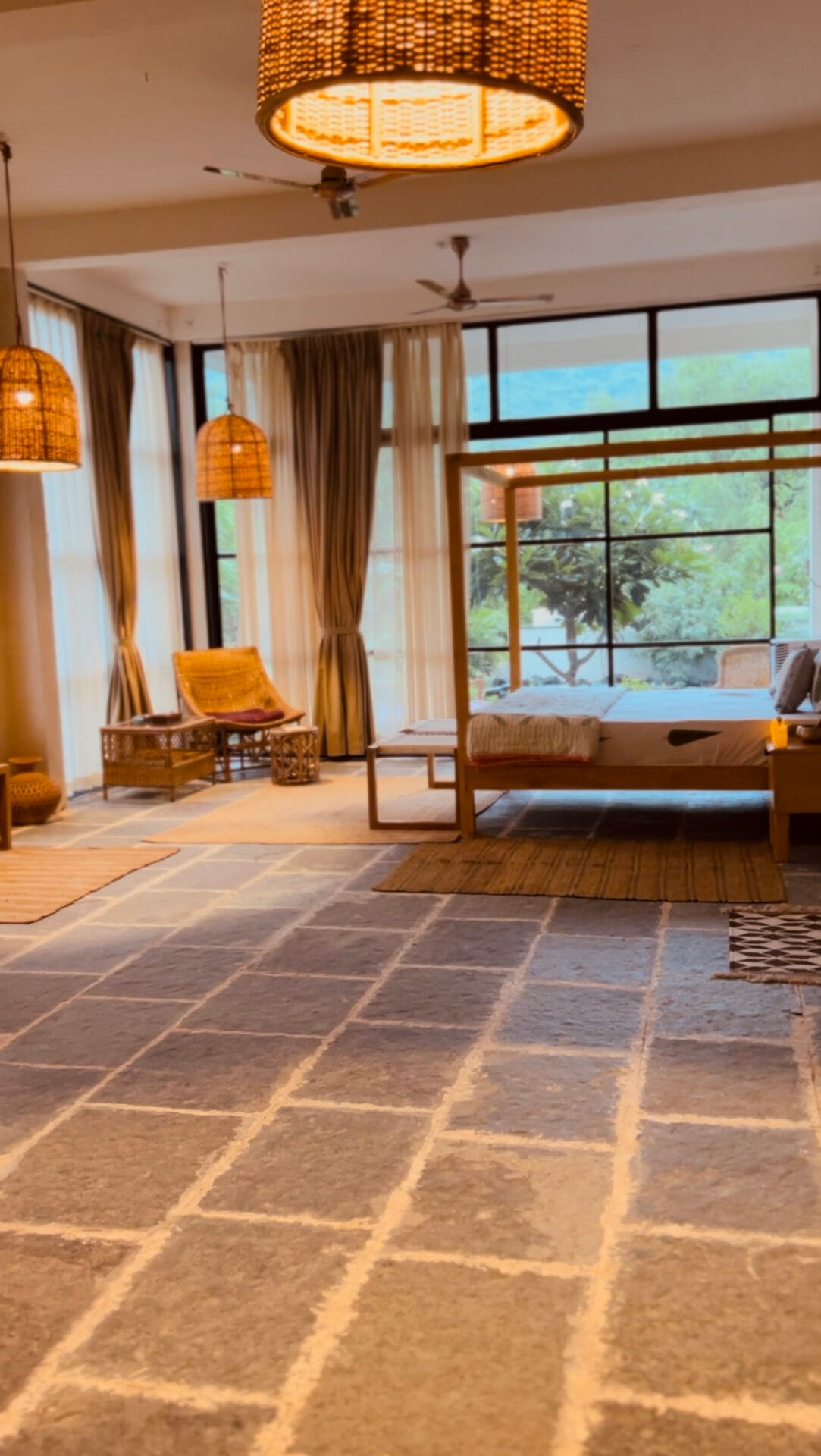
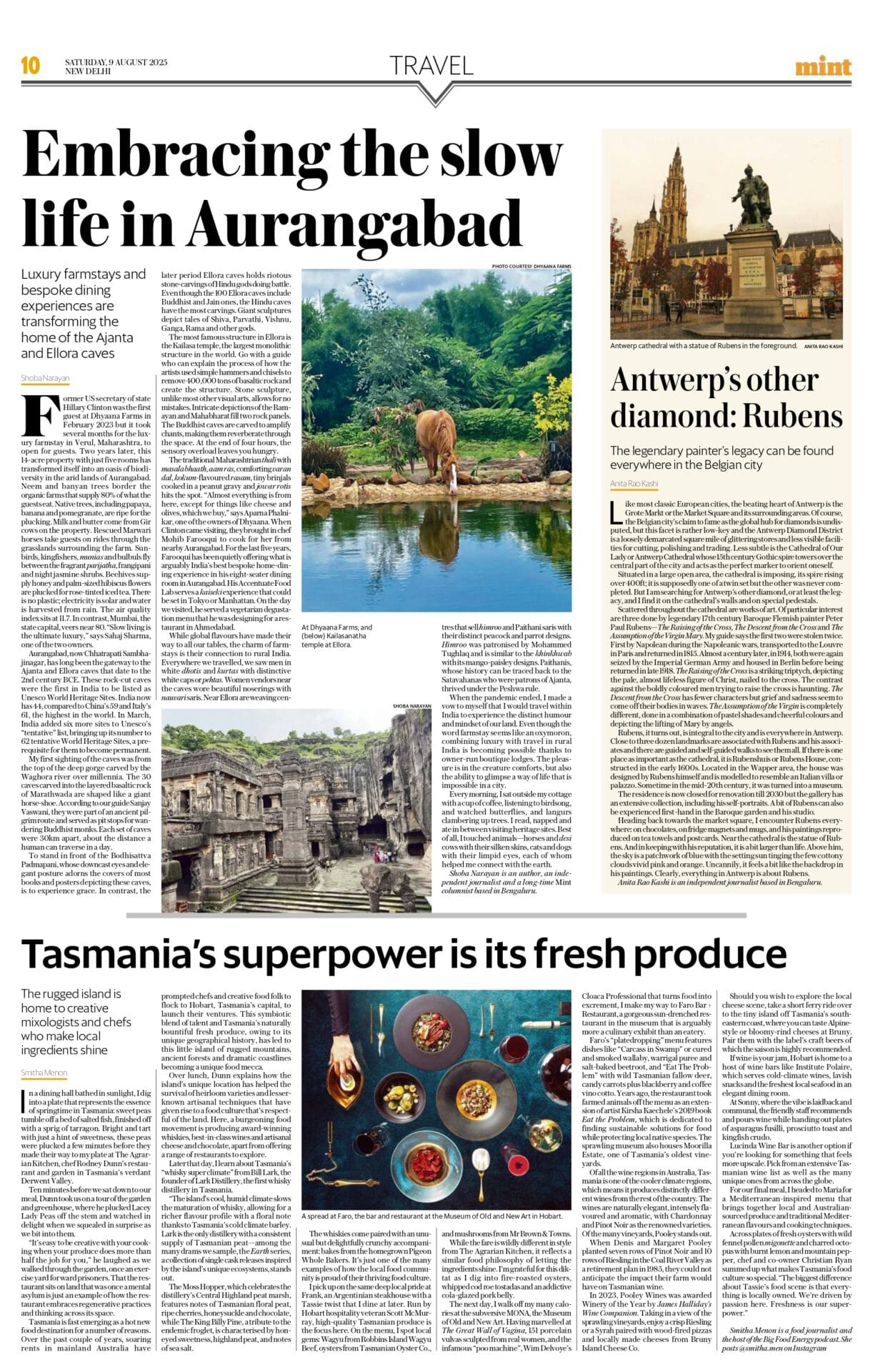
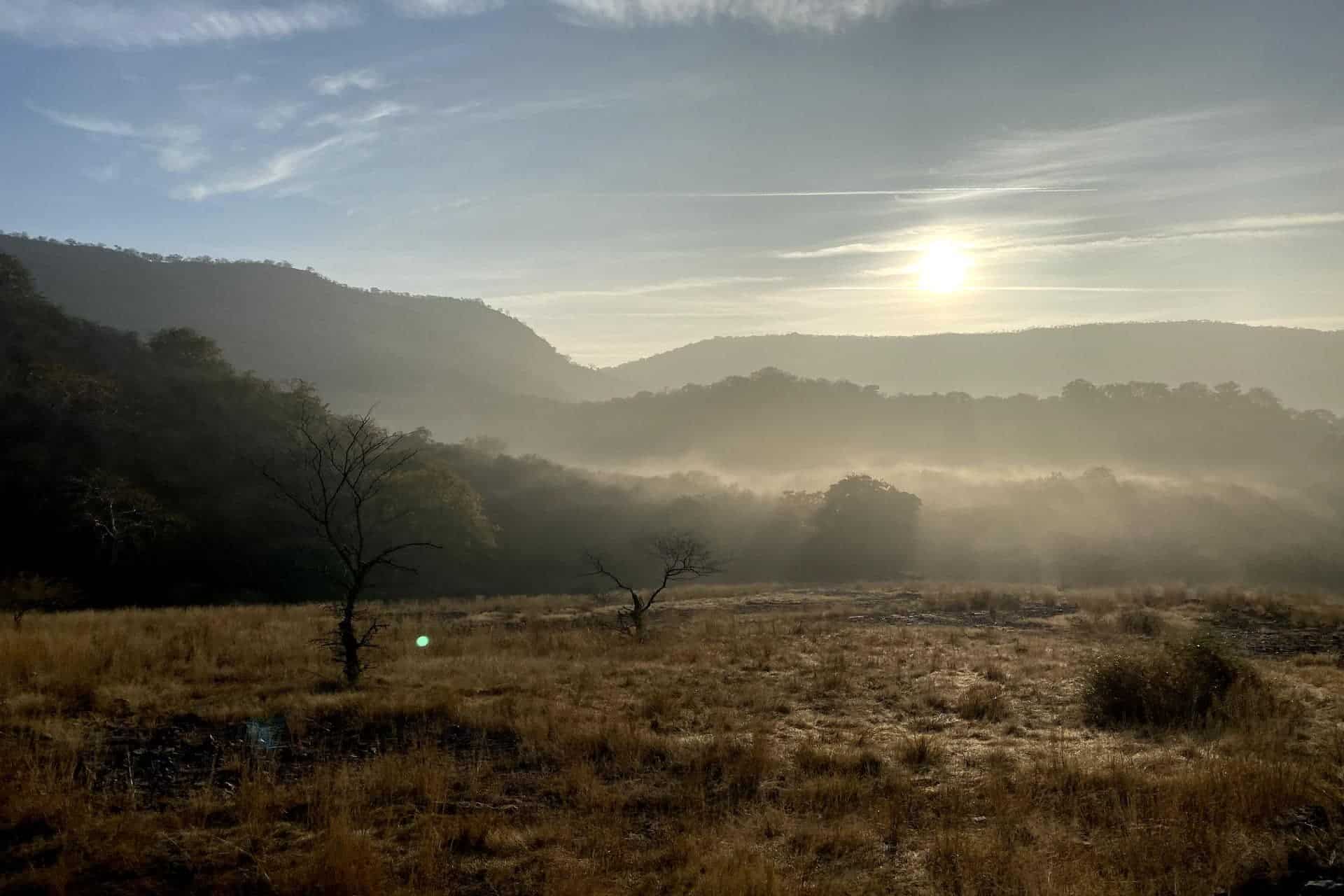
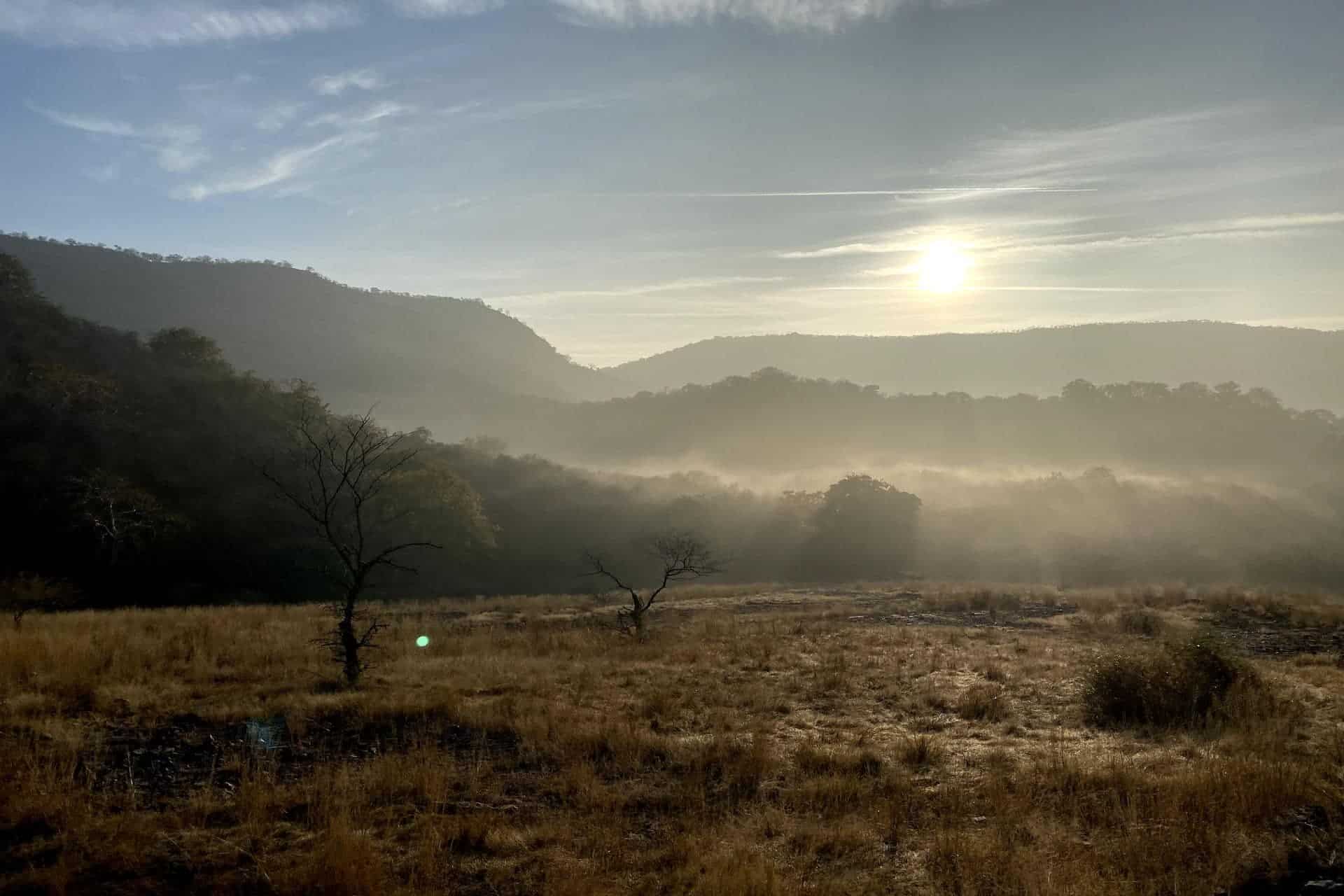
Hillary Clinton was the first guest at Dhyaana Farms in February 2023 but it took several months for the luxury farmstay in Verul, Maharashtra, to open for guests. Two years later, this 14-acre property with just five rooms has transformed itself into an oasis of biodiversity in the arid lands of Aurangabad. Neem and banyan trees border the organic farms that supply 80 percent of what the guests eat. Native trees including papaya, banana and pomegranate are ripe for the plucking. Milk and butter come from the native Gir cows on the property. Rescued Marwari horses take guests on rides through the grasslands surrounding the farm. Sunbirds, kingfishers, munias, and bulbuls fly between the fragrant parijatha, frangipani, and night jasmine shrubs. Beehives supply honey and palm-sized hibiscus flowers are plucked for rose-tinted iced tea. There is no plastic on the property. Electricity is entirely powered by the sun and water is harvested from rain. Best of all, for Indians who live in polluted cities, the Air Quality Index is a stupendous 11.7. In contrast, Mumbai, the capital city, veers near 80. “Slow living is the ultimate luxury,” says Sahaj Sharma, one of the two owners.
Aurangabad (now christened the rather mouthful Chhatrapati Sambhajinagar) has long been the gateway to the Ajanta and Ellora caves, that go back to the 2nd century BCE. These rock-cut caves were the first in India to be listed as UNESCO World Heritage Sites. India now has 44, compared to China’s 59 and Italy’s 61, the highest in the world. In March 2025, India added six more sites to UNESCO’s “tentative” list, bringing up its number to 62 tentative world heritage sites, a prerequisite for them to become permanent. But Ajanta and Ellora were the first and perhaps the reason why every schoolchild in India knows about them.
My first sighting of the caves was from the top of the deep gorge carved by the Waghora river over millennia. There they were, the 30 caves carved into the layered basaltic rock of Marathwada, shaped like a giant horse-shoe. According to our excellent guide, Sanjay Vaswani, these caves were part of an ancient pilgrim route and served as pit-stops for wandering Buddhist monks. Each set of caves were 30 kms apart, about the distance a human can traverse in a day.
Walking inside the 30 Ajanta caves, each carved with Buddhas and Bodhisatvas, is like having your chakras massaged. To stand in front of the Bodhisattva Padmapani whose downcast eyes and elegant posture adorns the cover of most books and posters depicting these caves is to experience grace. That said, most of the caves are also stark and unchanging with sculpture after sculpture of the Buddha in repose. In contrast, the later-period Ellora caves holds riotous stone-carvings of Hindu gods doing battle.
Even though the 100 Ellora Caves include Buddhist and Jain ones, the Hindu caves have the most carvings. Giant sculptures depict tales of Shiva, Parvathi, Vishnu, Ganga, Rama and other gods. There are several stone-carvings of Ravana trying to shake Mount Kailash. How do you show movement in stone? This is the central question for a sculptor.
The most famous structure in Ellora is the Kailasa temple, carved from a single rock. It is the largest such monolithic structure in the world. Go with a guide who can explain or rather fathom the process of how the artists used a simple hammer and chisel to take out some 400,000 tons of basaltic rock to create the structure. Stone sculpture, unlike most other visual arts, allows for few or no mistakes. You chip the nose away from a god or goddess and that’s it. The whole effort is wasted. The artists who created the many carvings at Ellora including intricate depictions of the entire Ramayana and Mahabharata in two rock panels, massaged the rock in ways that are stupendous. The Buddhist caves here, for instance are carved so that chants are amplified and reverberate through the space. At the end of four hours, the sensory overload makes you hungry.
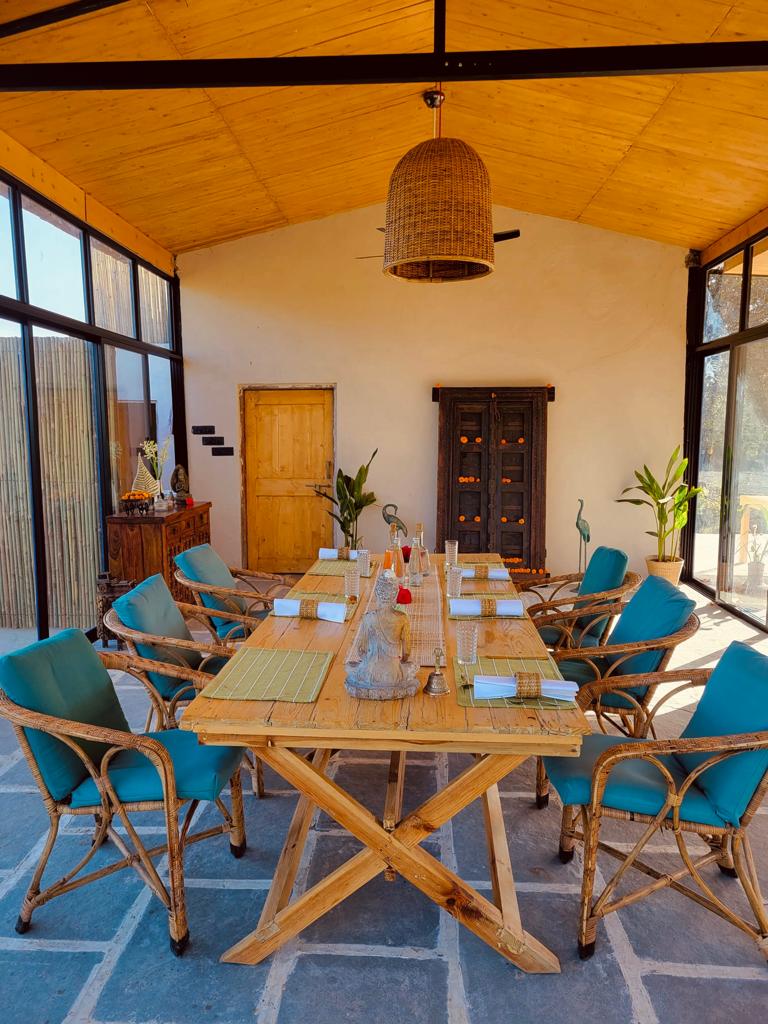
One of the meals at Dhyaana Farms where my husband and I stayed was a traditional Maharashtrian thali with delicious masala-bhaath, aam-ras, comforting varan-dal which my spice-averse husband loved, kokum-flavoured rasam, tiny brinjals cooked in a peanut-flavoured gravy, and jowar rotis. Each meal was sumptuous with the chefs literally walking to the kitchen with clusters of greens for the day’s meal. Dinner included wine from neighbouring Nashik. The highlight though, was a tea party that they set out on the shrub grass right beside the mountain. “Everything is from here, except the cheese and olives, which we buy,” says Aparna Phalnikar, one of the two owners.
When Hillary Clinton came visiting, Sahaj and Aparna (partners who are not married to each other) prevailed upon Chef Mohib Farooqui to come cook for her. For the last five years, Farooqui has quietly been offering what is arguably India’s best bespoke home-dining experience in his 8-seater dining-room in Aurangabad. His Accentuate Food Lab serves a kaiseki experience that could be set in Tokyo or Manhattan. Farooqui who grew up in Saudi Arabia and studied in Australia is influenced by Levantine flavours. On the day we visited, he served an entirely vegetarian degustation menu that he was designing for a restaurant in Ahmedabad.
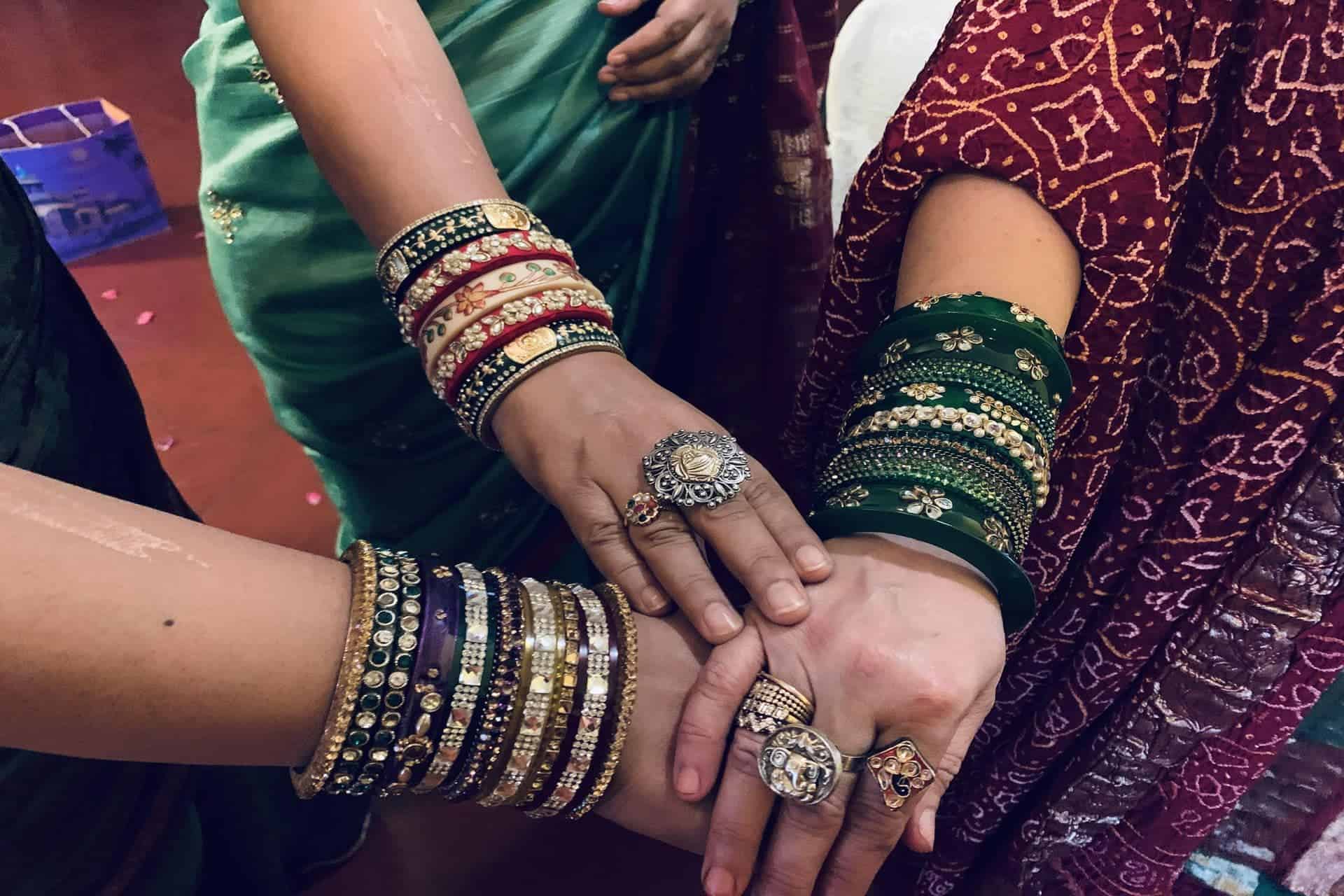
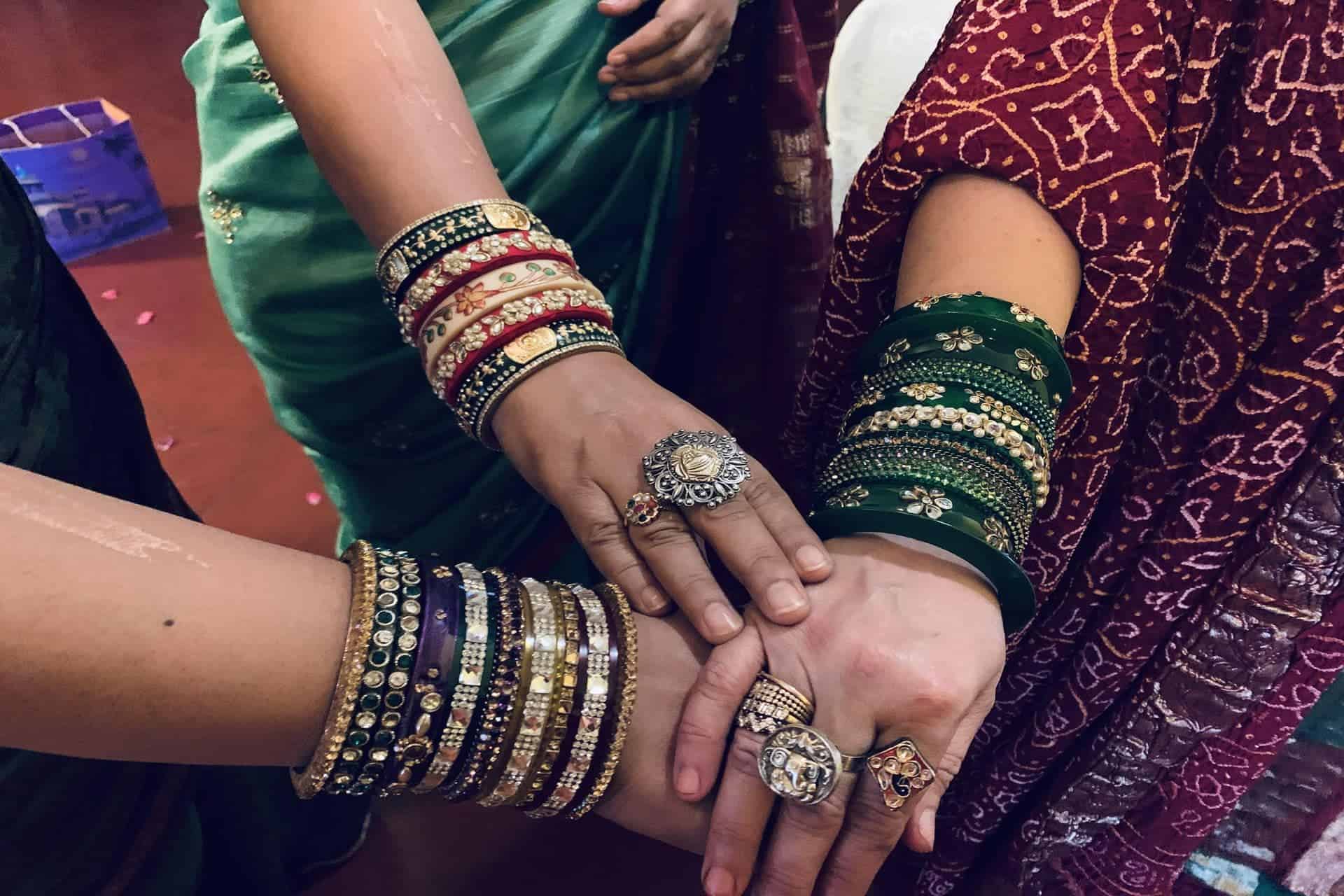
While global flavours have made their way into all of our tables, the charm of farmstays is their connection to rural India. Everywhere we travelled, we saw men in their white dhotis, matching kurtas, and distinct white caps or pehtas. Women vendors near the caves wore beautiful naths or noserings with navvari saris, perfect for balancing wicker baskets on heads and walking through the fields.
Textiles are grand all over India. Near Ellora are weaving centres that sell Himroo and Paithani sarees with their distinct peacock and parrot designs. Himroo was patronized by Mohammed Tughlaq and is similar to the Khinkhwab with its mango-paisley designs. Paithanis, whose history can be traced back to the same 2nd century BC Satavahana dynasty that were patrons of Ajanta, thrived under the Peshwa rule. At the shops I visited, all near Ellora, silk paithanis ranged in price from Rs. 11,000 to over 1 lakh. I bought a cotton paithani for Rs. 6500. What I wanted was the parrot motifs that I so loved in this weave. And no, even though everyone wore a version of the humble Kolhapuri chappals that Prada has now made-famous, I didn’t find a shop selling it here.
When Covid ended, I made a vow to myself that I would travel within India, mostly to small towns and if possible rural India to experience the distinct humour and mindset of our land. Even though the word farmstay seems like an oxymoron, combining luxury with rural India is becoming possible these days thanks to owner-run boutique lodges. The pleasure of staying in these places is of course the creature comforts, but also the ability to glimpse a way of life that is impossible to access when you live in a city.
Every morning, I sat outside my cottage with a cup of coffee, listening to birdsong (I counted 45 species of birds), watched blue butterflies, and made faces at the langurs that clambered atop the trees on the property. I read, napped, and ate in between visiting heritage sites. Best of all, I touched animals– horses and beautiful desi cows with their silky shivering skins, cats and dogs with their limpid eyes, each of whom in their own way, helped me connect with the earth and heal.
-k4lD-U204025897261YmH-250x250%40HT-Web.jpg "Shoba Narayan")
Shoba Narayan is Bangalore-based award-winning author. She is also a freelance contributor who writes about art, food, fashion and travel for a number of publications.



Leave A Comment