
The thought occurred when a friend sent a message saying that yet another Italian restaurant had opened in Bangalore. And although I could intuitively grasp the answer, I had to (again) ask the question: why is Bangalore in love with Italian food? Why do we choose this cuisine above all else, to eat in restaurants, serve at home and make for our kids? We no longer think of it as exotic but rather view it as comfort food, along with ramen noodles, prawn curry, and maybe chicken tikka masala. Actually, this guess is perhaps wrong because Bangalore is now so cosmopolitan that comfort food will depend on the community: neer dosai for some, lamb chops for others, and curd rice for many. Actually, if you think of one comfort food for the many castes (a caste census did happen after all in Bangalore recently) and communities in Bangalore, it may well be curd rice.
This love for Italian may be true in all of India, but since Bangalore is our lens, I ask it here; because I think we in this particular metropolis are different; because I think there is a special and specific reason why Bangaloreans love Italian food. It has to do with our shavige bhaath, a breakfast and teatime dish made with vermicelli.
At its core, Bengaluru’s indigenous food culture is built on what can be called a “carb-plus-condiment” combo. Think of the basic tiffin, served at countless Udupi restaurants or the Darshini ecosystem. What does it contain? A carbohydrate that serves as the delivery vehicle for a gravy. This carb, be it the idli, dosa or vada, is designed to be paired with a wet, flavour-packed, often spicy accompaniment such as the sambar or chutney. So it has been since approximately A.D. 920, when the earliest extant work in Kannada literature, Vaddaradhane, a series of 19 stories written by an unknown Jaina monk, variously called Revakotyacharya and later, Sivakotyacharya, listed 18 items of food including iddalige, sodige, sevanige, ladduge, etc. as the things people ate before finishing the meal with betel.
The city’s other great culinary love, the one-pot rice meal, be it bisi bele bhaath or chitranna (lemon rice), follows the same principle. There is a neutral rice base imbued with a spice-lentils-vegetable mixture.
Now think of Italian food. A bowl of pasta is, in a way, pretty identical in structure to our South Indian food. Pasta or pizza dough form the carbohydrate base. On top are the wet accompaniments, be it a pesto or tomato sauce. Then there is the seasoning. Instead of our saasuve (mustard seeds) and jeerige (cumin), the Italians use oregano and thyme. You could think of a pizza as a glorious open-faced uthappam. This similarity of approach towards cooking makes Italian easy for us to stomach, both intellectually, emotionally, and well, physically. The emotional bit is trickier. All of us can intellectually accept and admire foreign cuisines. We wax eloquent about Brazilian barbeque and Japanese sushi. But how often do we make these things at home? Home cooking is the signal for when a specific food moves from a foreign land into our land and home. Italian has. For the Bangalorean palate, a bowl of spaghetti is not a foreign concept. It is just a thicker shavige bhaath, with a few bland flavours on top. Something we can make at home.
Not so with Japanese or Mexican cuisines, both of which have made inroads into Bangalore. Some of our top restaurants in Bangalore are Japanese. But these still remain exotic foods, not cooked at home and largely contained to expensive restaurants. This is because they require specialized tools and have fermented and fishy flavours, that not all Indians like. Italian on the other hand, relies on a triumvirate of seasonings that are almost identical to the Indian. In India, our khaandha or seasoning-group is ginger-garlic-onion-tomato. I
Such compatibility at the ingredient level is critical when it comes to marketing a foreign cuisine to finicky vegetarians. Italy’s cucina povera (peasant cooking) tradition has a vast range of recipes that are inherently vegetarian, not vegetarian by omitting the meat. No wonder Italian food feels familiar, even to Jains.
The other side of the equation is our desire to feel global. Thanks to the tech and startup world of Bangalore, we now have a global corporate culture. For a new class of well-travelled tech professionals, Italian has become the lingua franca of food. When you take out your team for dinner and you don’t want Indian, what’s better than pizza? A crowd-pleaser that offers something for everyone; that feels foreign and sophisticated but is not intimidating. When any client comes visiting Bangalore, whether from the US, Europe, Asia or the Middle East, you can safely take them out for Italian. What’s interesting is that now, we are moving towards a more Italian enjoyment of its cuisine. We want al dente pasta, we discuss whether burrata is better than mozzarella, and we have learned to pronounce cacio e pepe instead of just saying ‘white sauce.’ A far cry from the time my parents would say “piece-aaa.” We are proud, not just of our global palates, but also the cultural capital that accompanies this sophistication. We have become what Arjun Appadurai calls “glocalized.”
I am just waiting for the day when “masala pasta” will become Italy’s national dish, much like chicken tikka masala has become Britain’s favourite.
-k4lD-U204025897261YmH-250x250%40HT-Web.jpg "Shoba Narayan")
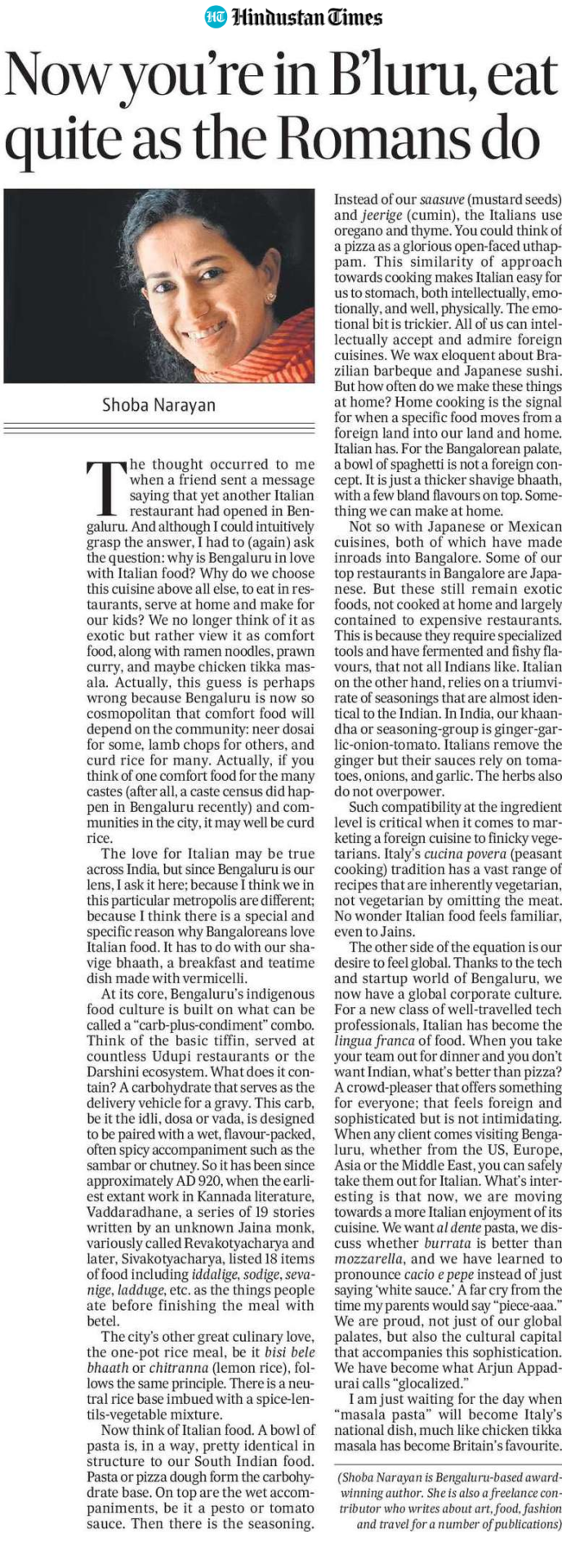
Shoba Narayan is Bangalore-based award-winning author. She is also a freelance contributor who writes about art, food, fashion and travel for a number of publications.






Leave A Comment