
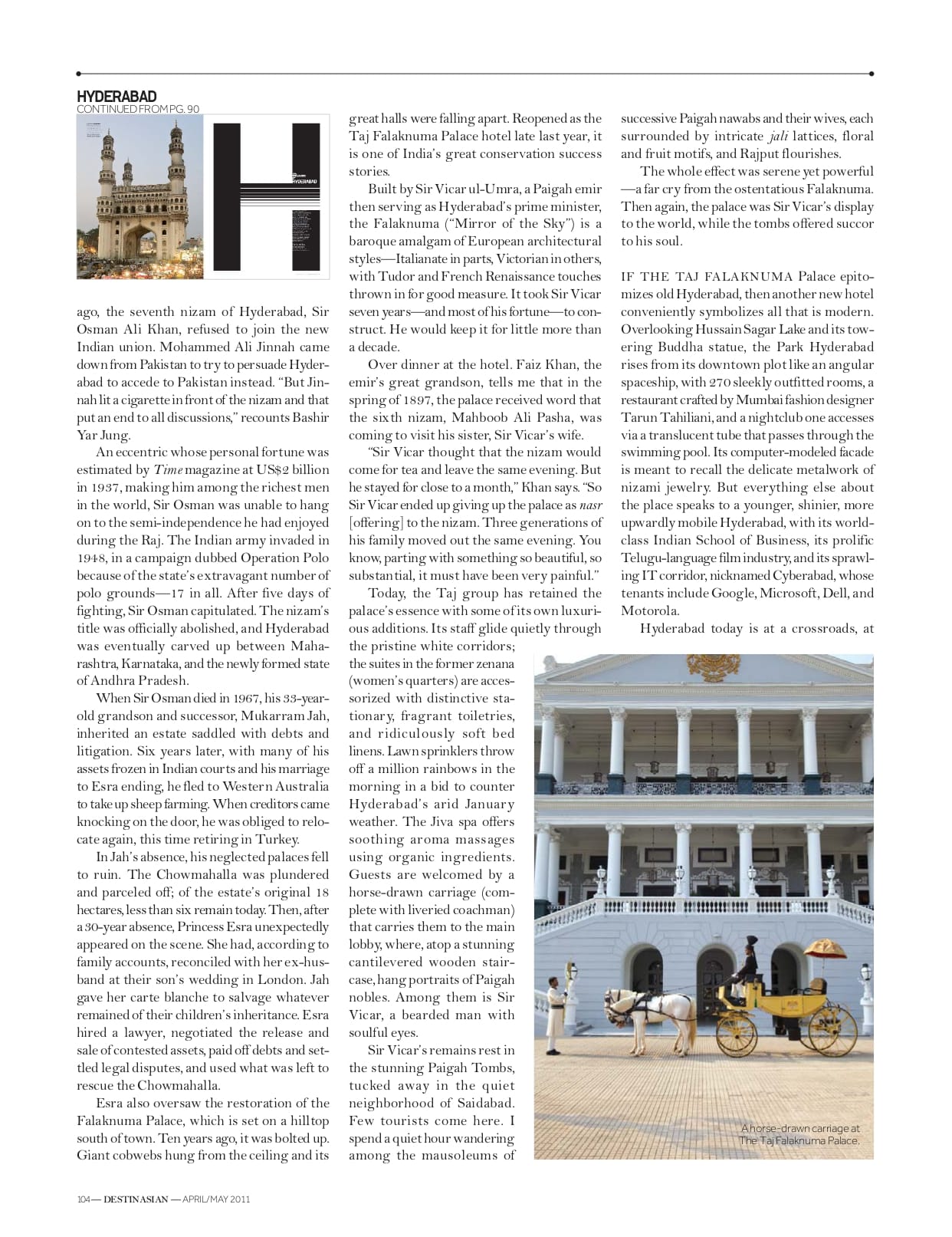
“What would you like, Madam? Burqa or Bollywood mini-skirt?” asks the smiling young urchin as he trails me through Laad Bazaar.
Tiny shops line the dusty bylanes around Charminar (four minarets) in the heart of the Old City. On one side hang burqas, henna patterns, patterned headscarves, and other chaste Islamic accessories. Across the street is what a local calls “bling-mania.” A riotous display of diaphanous candy-pink skirts and revealing sequined tops in the style preferred by Bollywood heroines. “This particular miniskirt is like the one Bipasha wore in Dhoom,” says my new friend. “College girls love it. And Madam has the shape for it.”
He looks about ten but has the assessing eyes of an 18-year-old.
“What would Madam like?” he asks again. “Kajal, henna, surma, blouses, embroidery, bangles, bags? We have everything.”
What I am looking for is romance– an epic romance really. In 1591, Mohammed Quli Qutb Shah, the aquiline poet prince whose portrait hangs in the Smithsonian, fell in love with a Hindu maiden called Bhagmati, and moved his capital from Golconda to what was then Chichlam village, on the banks of the Musi river. He named the city after his beloved, who he called Hyder Mahal.
“Hyderabad is a city born from love,” says my guide Jonty Rajagopal, who left her job at the Gates Foundation to start a tour company. “Shah Jahan built the Taj Mahal, but Quli Qutb Shah built an entire city for his beloved.”
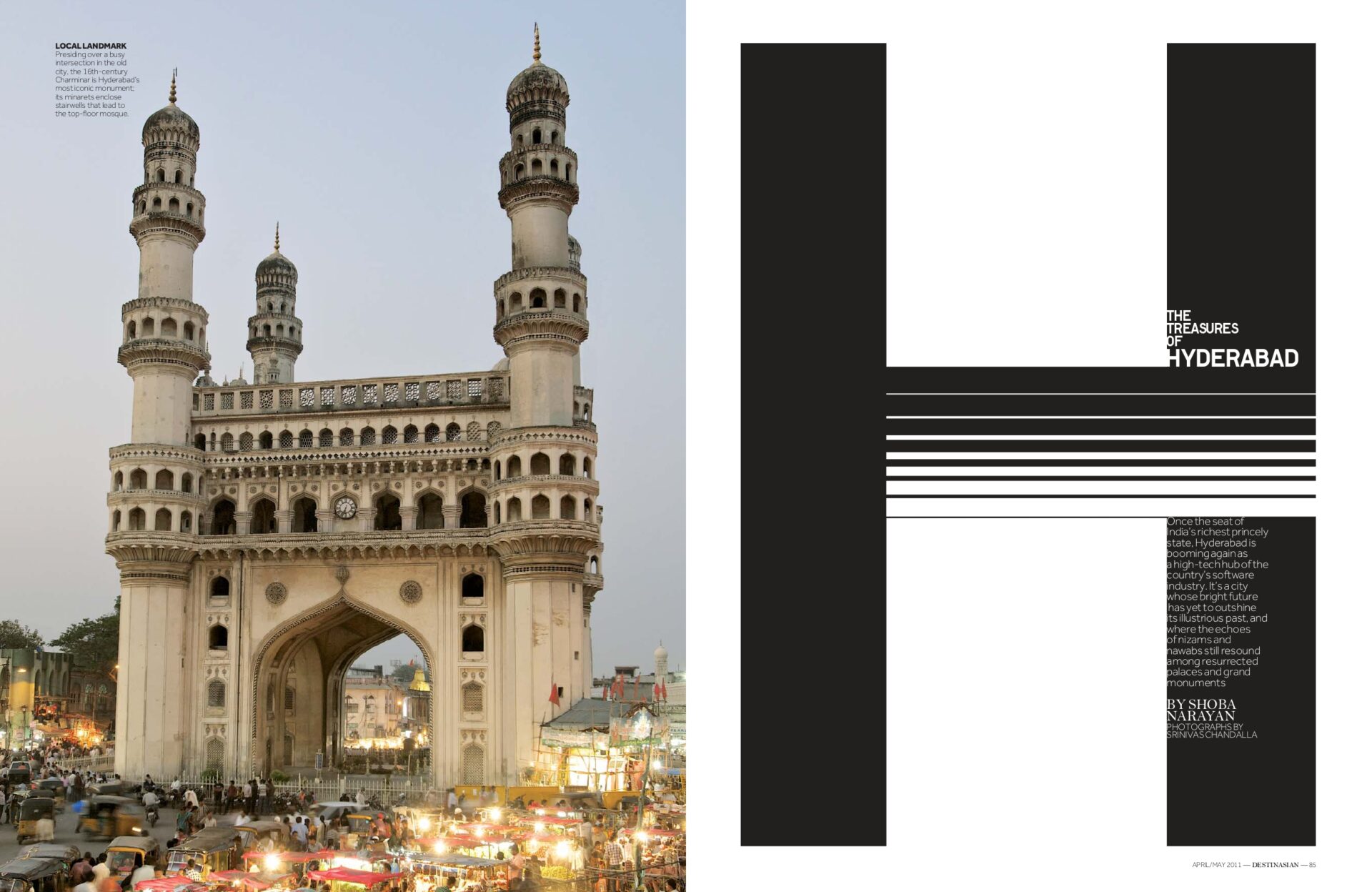
We are sitting at Farasha, an Irani café in the shadow of Charminar. College girls in tight jeans and T-shirts walk by. Burqa-clad women clutch children sucking on neon-green popsicles. Everywhere, there is the sound of bargaining; the sound of commerce, as people buy chilled young cucumbers spiked with red chili powder, plastic buckets piled high like Subodh Gupta sculptures, Unani medicines that promise to give “strength” at night, and countless tempting trinkets. Motorbikes and auto-rickshaws whirl around Charminar, where Qutb Shah prayed to Allah to release his city from the clutches of the bubonic plague of 1591, and erected the monument in gratitude. Across the street, ten thousand of the faithful can come together at one time to worship at Makkah masjid, among the largest and holiest mosques in India with bricks made using soil from Mecca.
This preoccupation with Persian and Arabic culture continues in Hyderabad to this day. Hyderabadi Muslims speak Urdu mixed with words from Turkish, Arabic and Persian. Elaborate courtesies are accorded to visitors and ‘meethi bhol,’ or sweet speech is encouraged. Etiquette, custom and tradition are important and even the smallest child is inculcated with a behavioral code that some find stultifying and others, refreshing.
Modelled on Isfahan in Persia, Hyderabad was a city of gardens, fountains, palaces, and reservoirs for moon-watching. The original Charminar complex had 14,000 shops, public baths, mosques and homes along the four roads that radiate out of the edifice. I am on one of them— the famous Laad Bazaar where lac and rhinestone bangles are stacked high in mirrored display cases and glitter like compressed stars.
In the back are the workshops, where bare-torsoed men melt the lac over coals, beat it flat, and shape it into circles. While the lac is still warm, jewelers with nimble fingers press rhinestones into the bangles. Butterflies, flowers, and even the Taj Mahal are used as patterns. They look like Judith Leiber handbags.
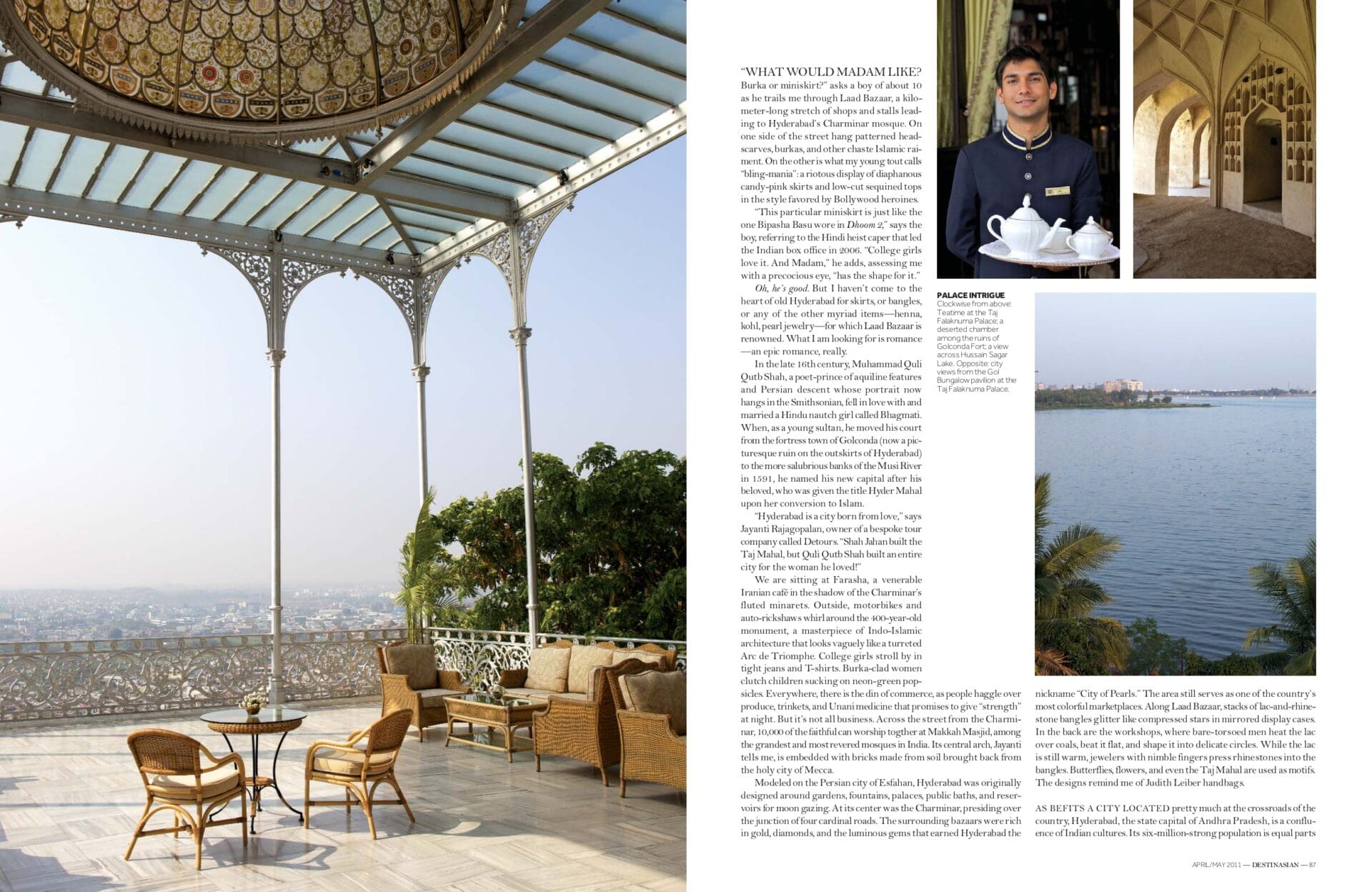
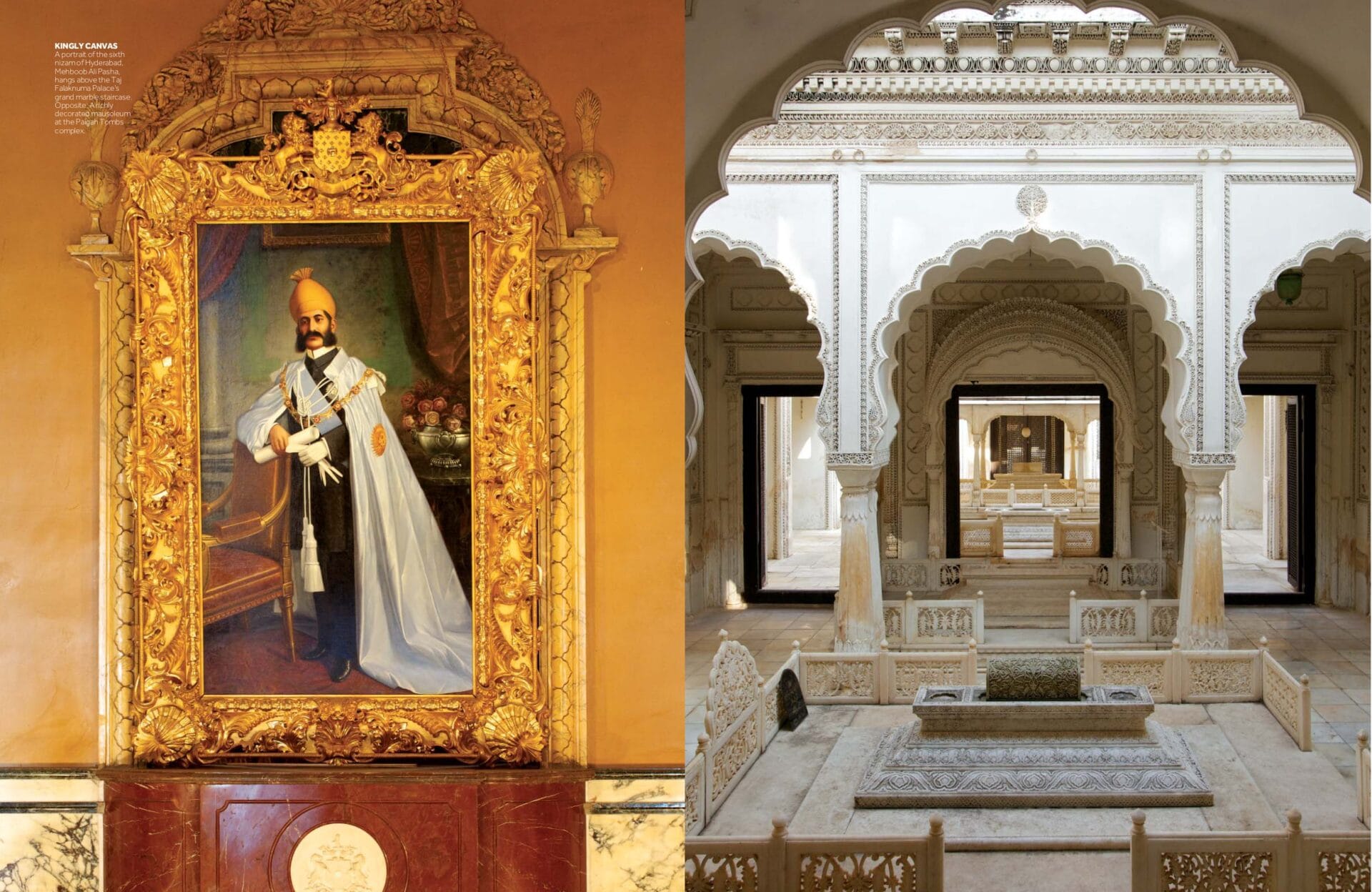
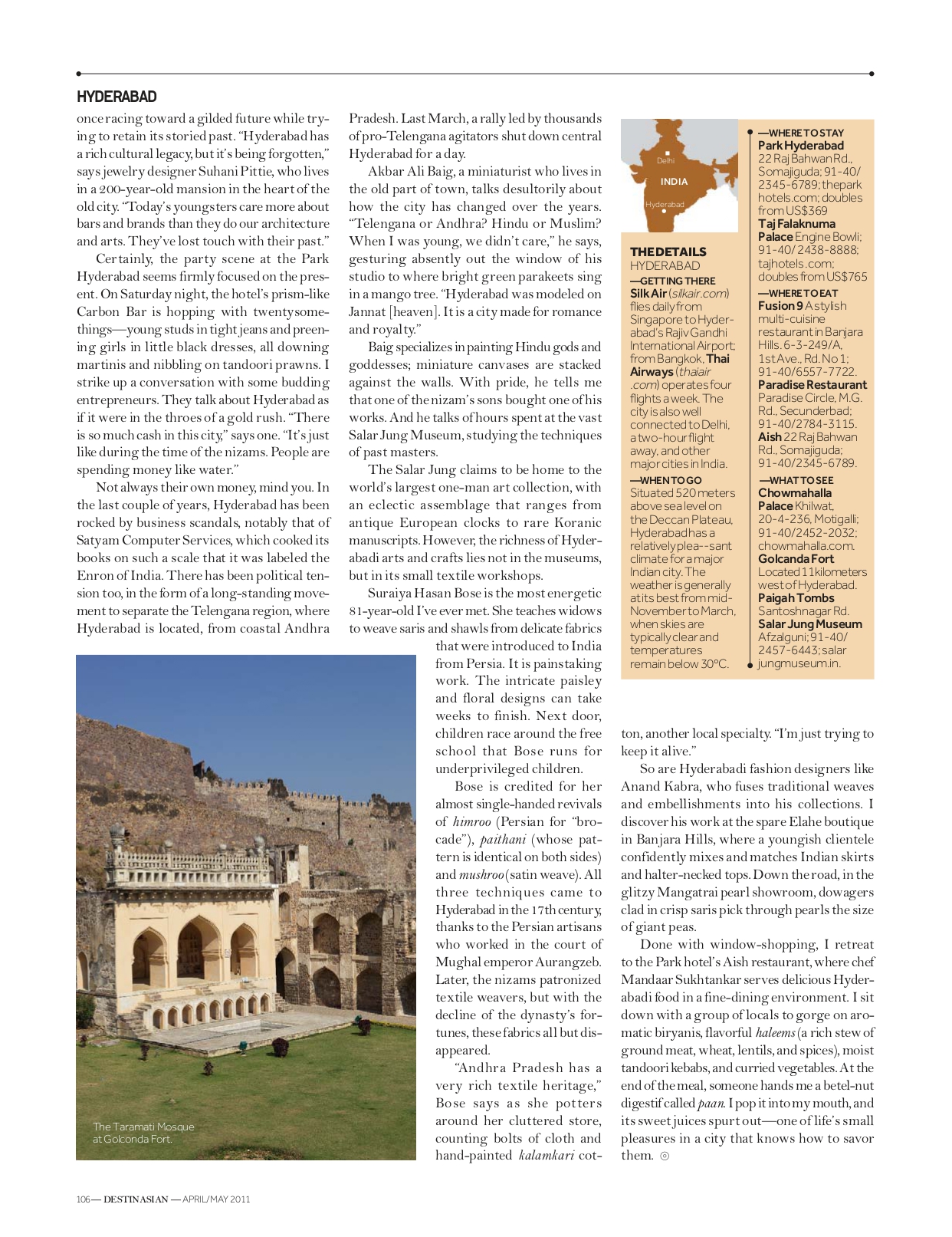
Today there are two Hyderabads—the old and new—each conveniently epitomized by two new hotels that have sprung up. The Taj Falaknuma Palace reflects the old splendour of the Nizams— their sense of grandeur and entitlement; their love of luxury, pomp and circumstance; their extraordinary largesse combined with extreme pettiness; their quaint etiquette and strict social protocols that seem alive (if meaningless) to this day.
“At the Taj hotel’s opening party, I went up to His Highness Udaipur and asked him if he was comfortable, even though Hyderabad was much above Udaipur in the Delhi Durbar,” says Faiz Khan, whose Paigah ancestors built the palace.
The Taj Falaknuma Palace, much like the rulers who built it, is removed from the city, atop a hill, and rises up in surreal contrast to the surrounding landscape. It looks like Versailles, except set in Mumbai—or Hyderabad.
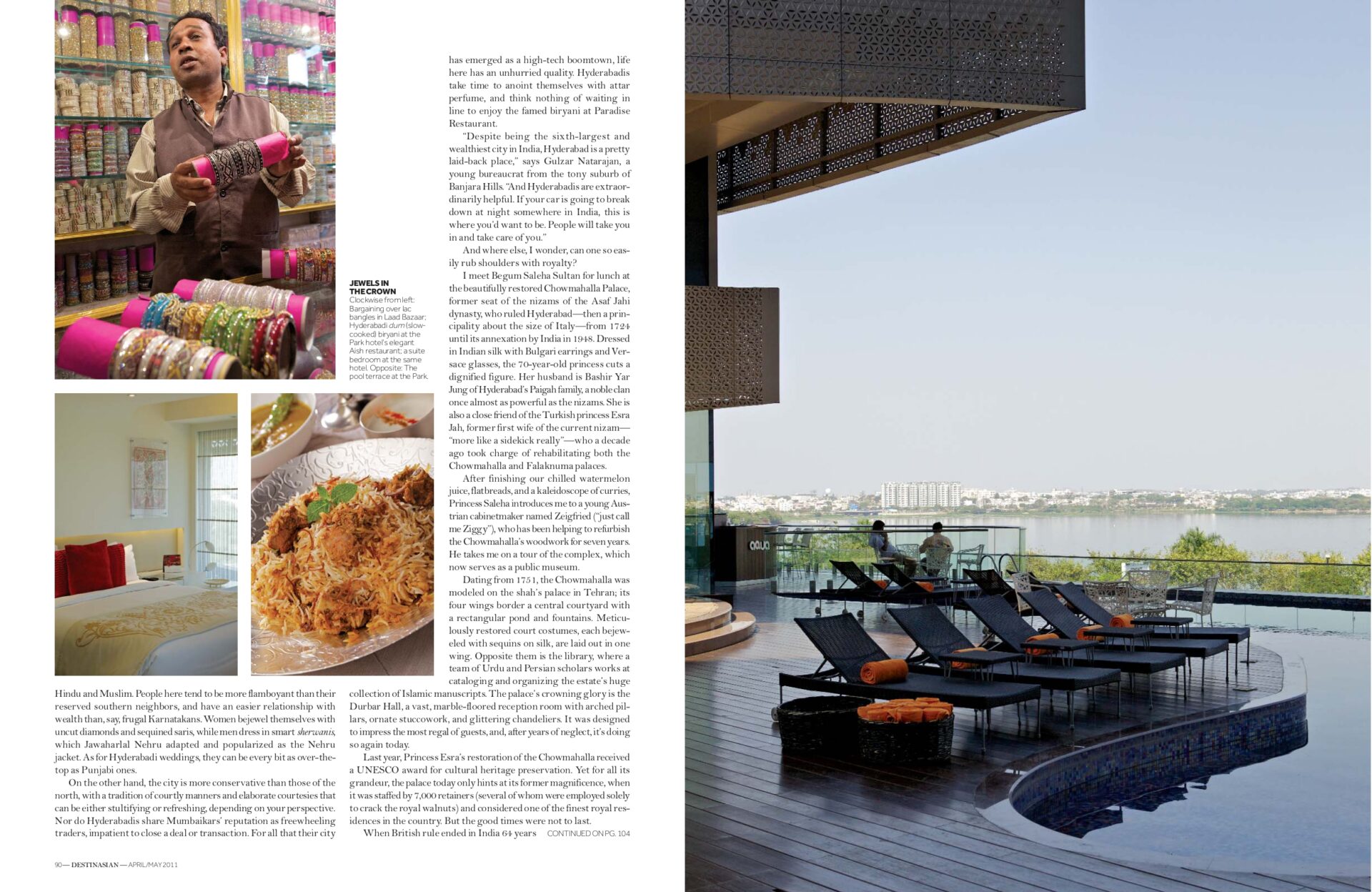
In the heart of the city, just past Hussain Sagar Lake with the 18-meter tall monolithic Buddha in the center, the Park hotel rises like a spaceship, with its modern fixtures and glitzy façade. When it opened, taxicabs screeched to a halt just outside to the hotel as cabdrivers looked up in amazement. The Park epitomizes the new Hyderabad, with its world-class Indian School of Business (ISB) and sprawling IT corridor, nicknamed Cyberabad– an allusion to the software companies that dot its landscape. “In spite of its bustling entrepreneurial spirit, Hyderabadis are pretty laidback and extraordinarily helpful,” says Gulzar Natarajan, the young district collector as he rushes around, siren wailing, police escort cars in tow, from his home in the tony Banjara hills to a party rally across town. “If your car breaks down at night, this is the city you’d want to be stuck in because people will take you in and take care of you.”
As befitting a city located pretty much in the center of the country, Hyderabad has the best and worst of both North and South India. It is more flamboyant than its reserved Southern neighbours. Hyderabadi weddings are just as ostentatious as Punjabi ones. Women wear uncut diamonds and sequined saris; while the men are clad in sherwanis, which Jawaharlal Nehru adapted and popularized as the Nehru jacket. Hyderabad has an easier relationship with wealth, unlike say, self-righteous Kerala, frugal Karnataka or introspective Tamilnadu. On the other hand, with a population that is equal parts Hindu and Muslim, Hyderabad is more conservative than its North Indian cousins. Hyderabadis aren’t freewheeling traders like Mumbaikars, impatient to close a deal or transaction. This ‘city of pearls’ has a slower rhythm and an appreciation for the leisurely charms of life. Hyderabadis take time to anoint themselves with attar perfume, enjoy a well-layered biriyani at Paradise restaurant or wait in line for a loaf of Irani bread along with their morning ginger-tea. Time is stretchable and family trees are flexible. “We don’t delve too deep into relationships here, because you don’t know if it is legitimate or illegitimate,” says Princess Saleha Sultan of the Bhopal royal family.
I meet Her Highness Bhopal at the beautifully restored Chowmahalla Palace. She is entertaining a Lord and Lady Lester from England and invites me to join them for lunch in the palace grounds. With her Bulgari earrings, Versace spectacles and Indian silk attire, the Princess, like royalty anywhere, is suave and worldly. She was sent to Switzerland by private plane for her education, and has just returned from Mecca, where the family maintains a home for the pilgrims. Her husband, Bashir Yar Jung, is a Hyderabadi royal belonging to the Paigah clan.
Over lunch of chilled watermelon juice, Indian flatbreads and several curries, Princess Saleha regales us with stories of her children and grandchildren. She is a close friend of Princess Esra Jah, the current Nizam’s first wife— “more like a sidekick really”—who took charge of restoring both the Falaknuma and the Chowmahalla palaces.
Princess Esra belongs to the Turkish royal family and spends most of her time abroad. Since the opening of the Taj hotel, she is building a private residence in the compound. A young Austrian cabinet-maker, Zeigfried (“just call me Ziggy”) is fashioning her furniture and helped restore the woodwork of the Chowmahalla.
Ziggy, who has lived and worked in Hyderabad for seven years, takes me on a tour of the Chowmahalla (Four Palaces) Palace, the seat of the Asaf Jahi dynasty, once the richest in the country. Asaf Jah was a viceroy who broke away from the Mughals in 1712 to establish his own potentate in Hyderabad. He was given the title Nizam ul-Mulk and so it continues to this day. Chowmahalla was built in the late 18th century and used for ceremonial receptions and ascensions. Of the original 45 acres, only 14 remain today, typifying the looting that went on when the current 8th Nizam fled to Australia and then Turkey to escape debts and settlements from his many wives and concubines.
Modelled on the Shah’s palace in Tehran, Chowmahalla’s four wings border a center courtyard with a rectangular water-pond and fountains. The Nizam’s costumes are displayed in one wing and the other houses a library with rare Urdu manuscripts. In the back is the living area with beautiful wooden floors, furniture with fabric imported from England.
When the British left India, the 7th Nizam, Sir Osman Ali Khan—who Time magazine dubbed the richest man in the world with a personal fortune of $2 billion in the 1940s—refused to give up his independence. Mohammed Ali Jinnah came down from Pakistan to try to persuade Hyderabad to accede to Pakistan instead of India. “But Jinnah lit a cigarette in front of the Nizam and that put an end to all discussions,” says Bashir Yar Jung, whose grandfather Vicar ul-Umra built the Falaknuma palace.
In September 1948, a year after independence, the Indian army stormed Hyderabad— called Operation Polo because of the city’s 17 polo grounds, the largest number in the country— and annexed it to the Indian Union. “It would have been more comfortable for me and my descendants if Hyderabad had remained independent. But to be landlocked and survive alone in the middle of India was a pipe dream,” says Jung.
We are sitting in his home in the Jubilee Hills area and drinking tea. His wife, Princess Saleha, is playing with their grandchild. “We inherited our love of music, art, fine food, wine and I must add, women, from the Iranian Qutb Shahi dynasty who were Shia Muslims,” says Jung. “The Nizam was a good poet and we remained heavily influenced by Persia till we came under the European influence. But that glory is now gone– like Ichabod Crane.”
“The Indian government took everything from us,” Princess Saleha adds. “But they didn’t run the country any better. Things are worse now.”
The Falaknuma certainly is better now. Ten years ago, it was bolted up. Giant cobwebs hung from the ceiling and the whole place was falling apart. One day, Princess Esra appeared on the scene. She had reconciled with her husband, the current Nizam who is exiled in Istanbul, during their son’s wedding. The Nizam gave her carte blanche over the two palaces. Esra hired a smart lawyer, settled all debts, sold most of the Nizam’s belongings to the Indian government and used the proceeds to restore both properties. It has taken a decade but the Taj Falaknuma has opened to rave reviews, and indeed, put the city on the global tourist map.
Built by Sir Vicar ul-Umra, a Paigah royal, the Falaknuma is a blend of European architectural styles. The story goes that Sir Vicar toured Europe for eight months in 1882, visiting the King and Queen of England, and the Dutch royalty. He wanted a perfect amalgamation of architectural styles. Thus was born Falaknuma or ‘mirror of the sky,’ with its light gray exteriors and sumptuous interiors.
One day, in the spring of 1897, the palace received word that the Nizam was coming to visit his sister who was married to Sir Vicar. There was a tradition that the Nizam’s family took wives from the Paigah family.
“Sir Vicar thought that the Nizam would come for tea and leave the same evening. He stayed for close to a month,” says Faiz Khan over dinner at the hotel. “Sir Vicar ended up giving up the palace as nasr (offering) to the Nizam. Three generations of the Vicar’s family moved out the same evening. You know, parting with something so beautiful, so substantial, is not easy.”
When the Nizam learned that Sir Vicar had nearly bankrupted himself to build the Falaknuma, he insisted on paying a part of it, and presented Sir Vicar with Rs. 68 lakhs—penny change, given that the Nizam owned 21 palaces, his own airlines, currency and countless Golconda diamonds including the 48-carat Jacob’s diamond, which he used as a paper-weight.
The Falaknuma had many visitors—the Japanese emperors, European nobility, the Czar of Russia and British rulers. But Sir Vicar’s soul rests in the stunning Paigah tombs, tucked away in the quiet Saidabad neighbourhood. Few tourists visit. I spent a quiet hour wandering through the tombs of successive Paigah rulers (they were called Amirs) and their wives, each surrounded by intricate jaali-work, floral and fruit motifs and Hindu touches. The whole effect was serene yet powerful—a far cry from the ostentatious Falaknuma. Then again, the Falaknuma palace was Sir Vicar’s display to the world while the tombs offered succor to his soul.
“I came to work here when I was a boy of 14,” says the Muslim caretaker, now on a wheelchair. “But I cannot bear to leave a place of such beauty so I am still here.”
Today, Hyderabad is at the crossroads, at once racing towards a gilded future while trying to recapture and retain its glorious past. “Hyderabad is bestowed with a lot of culture but its youth are quite confused,” says jewellery designer Suhani Pittie who lives in a 200-year-old mansion in the heart of the Old City. “Today’s youngsters care more about bars and brands, which is sad because we have the most beautiful palaces and buildings. We could go crazy if we truly became Hyderabadis. How can you forget your past in order to find your future?”
The bar at the Park Hyderabad is hopping with youngsters– perhaps those same ones who Pittie was talking about. Young studs in tight jeans and girls in Little Black Dresses (LBDs) down martinis and nibble on tandoori prawns. Every single element ranging from the water-droplet shaped tables to the mood lighting to the infinity pool has a designer’s touch, and the attention to detail would make Mies van der Rohe smile.
I meet some local entrepreneurs. They talk about Hyderabad as if it were in the throes of a gold rush. “There is so much money in this city,” says one. “It’s just like during the Nizam’s times. People spend like water, and nothing has any value anymore.”
Hyderabadis love to eat and drink, and new bars and restaurants are popping up all over the city. Old favourites persist– like Famous Icecream, Niloufer’s Café for Irani chai and Osmania biscuits, Shaadab haleem and Paradise biriyani where people line up and wait for their number to be called.
Begum Mumtaz who runs a cookery school remembers a time when eating out at restaurants was just not done. Instead, Hyderabadi culture was all about fasting and feasting—at home. Dishes were tailored to the climate. “The reason why we use tamarind as a souring agent rather than yogurt which is used up North is because of Hyderabad’s dry heat. Tamarind prevents urticaria (a skin disease). For similar reasons, we don’t eat greens in the rainy season.”
Hyderabadi cuisine is legendary for its complexity, yet most of its residents call it ‘simple food.’ Haleem, a ghee-laden rich meaty dish, eaten at the end of the Ramadan fasts, is a Hyderabadi specialty as are its biriyanis—meat layered with rice, spices, vegetables, and nuts. “To test a biriyani, you throw a handful on the floor,” says Begum Mumtaz. “The rice has to separate. And after a wedding, we eat baasi (stale) biriyani the next day for added flavour. Kacchra biriyani or leftover biriyani uses all parts of the animal except trotters.”
Unlike coastal regions, Hyderabadi cuisine is very meat-based. People talk about legendary feasts in which piping hot lukhmi (square patties traditionally stuffed with minced meat) were stuffed with tiny live quail so that when the guests split open the lukhmi, the quail flew out. Kebabs, kurmas, chutneys and mutton-patties are all local favorites. During the hot summers, cooling drinks made of khus, saffron, vetiver and rose petals are stored at homes and served to children when they return from school. “I went to school in a purdah,” says the sari-clad Begum, no longer in purdah. “But there was no communalism then. Hyderabad was very cosmopolitan.”
Akbar Ali Baig, a miniature painter who lives in the Old City, echoes those same sentiments. “Hindu or Muslim? We didn’t care,” he says. “Hyderabad was modelled on Jannat (heaven).” Bright green parakeets sing in the mango tree outside his studio. “It is a city made for romance and royalty.”
We chat desultorily about how the city has changed over the years. Miniature paintings are stacked against the wall. Baig specializes in painting Hindu Gods and Goddesses. He recites poetry and offers tea. The Nizam’s son bought one of my works, he says, and talks of hours spent at the Salar Jung museum, learning techniques from the masters.
Salar Jung was a collector and his wide-ranging if eccentric collection is now stored in a spiffy museum, one of the largest one-man collections in the world. Highlights are the veiled Rebecca, created by an Italian sculptor and the rare manuscripts gallery that has Korans of different vintages and nationalities. But the richness of Hyderabadi arts and crafts lies not in the museums but in its small textile workshops.
Soraiya Hasan Bose is 81 years old but her energy is legendary. She teaches widows to weave himroo, jamavar and paithani fabrics that were brought from Iran to India by the Mughals. It is painstaking work. The paisley and floral designs are hand-woven and take weeks to finish, depending on whether it is a sari or a shawl. Next door, children race around the free school that Bose runs for underprivileged children. “Andhra has a very strong textile tradition,” Bose says. “Our weaves have Persian influence because of the Nizams. The Mughals brought in their floral motifs. We have Kalamkari or vegetable dyes that were introduced by the British. So you have all these different influences that come together here.”
With earthy brown tones and indigo accents, Kalamkari designs work well on home accessories—curtains, bedspreads and tablecloth. Bose potters around her cluttered store, counting rolls of fabric, ready for export. She is the wife of a freedom fighter and it shows in the simplicity of her cotton sari. When Mahatma Gandhi came to Hyderabad, it was in her father’s home that he made a bonfire of English mill-made cloth to promote India’s indigenous weaving tradition. The women at Hassan’s textile workshop are a link to that proud nationalistic history.
In the last couple of years, Hyderabad has been rocked by large business scandals, including Satyam Computer Services, which cooked its books and subsequently collapsed. Farmers in the Telengana region of the north want a separate state and are going on hunger strikes to support their cause. The government is in a state of flux with the Congress party trying to fend off regional politicians who are trying to usurp power.
In the glitzy Mangatrai pearl showroom, or the spare Elahe boutique where local fashion designers show their Indian-fusion clothes, all this political turmoil seems far away. Manicured women pick out pearl strings and flowing clothes made by local designer, Anand Kabra. Money changes hands. Friends go haleem-hopping. We eat and drink.
“Life is not about jewels and pearls,” sings the Urdu poet. “It is about simple pleasures.”
Outside the biriyani joint, someone hands me a betelnut ‘paan’ or digestif. I pop it into my mouth and it sweet juices spurt out. Life’s small pleasures in a city that knows how to savour it.



Lovely piece Shoba.
I grew up in Hyd, so loved it even more :)
Kudos! What a neat way of thiknnig about it.
Scary indeed! This boembr’ has gone on record to say that there’ll be an imminent blast in Kerala too! And that adds fuel to our fears The pic you’ve put up represents the spirit of all those Bengaluru’ professionals! Perhaps a stable WiFi/WiMAX network in Kerala would help people work from home/elsewhere more and thus reduce their proximity to potential blast sites! I’ve been reading your SEO blog for long speaks highly of you! He’s a school-buddy of mine, btw. Eagerly waiting to see you at BlogCamp!