
Before every festival, my mother used to walk through the bazaars to get a flavour of the season. She would enjoy the fresh turmeric plants and sugarcane stalks before Yugadi and come back refreshed. During the Christmas season, I do something similar. I go to the bakeries to smell the plum cakes and kuswar platters. The one closest to me is Thoms in Frazer Town and so I walk through to get the Christmas spirit. Malls do the same thing with their piped carols that sing, “Joy to the World,” and the fake Christmas trees, but somehow bakeries have the smell component and so I like them better.
Turns out that bakeries anchored Christmas baking for many families. Vivek Chandy grew up in Bangalore and can remember when his mother and grandmother would take their plum cakes to All Saints Bakery before Christmas. “Many people didn’t have ovens at home,” and in the month leading up to Christmas, these bakeries would be baking 50 cakes on any given day and five out of those fifty would be from ladies who didn’t have ovens at home, but wanted to mix the dough and soak the dry fruits in rum by themselves.”
Chandy also recalls giving the family turkey that was served for Christmas lunch to the Bangalore Club where it would get roasted. Imagine families carrying over their roast chicken or turkey to a club and getting it roasted.
Both All Saints and Fatima Bakery in Richmond Town have been in existence for decades, and families still go to them to buy their mince pies, cakes and cookies.
The Cantonment area where I live has several bakeries but Thoms and Alberts are the big names. Alberts was set up as a godown in 1902 from which Mohammed Sulemn would supply cakes and biscuits to the area. It is still run by the same family. I go there for its hot cross buns in December, but come away with its iconic khoya naan, a flaky creamy concoction that melts in the mouth and is best had hot.
For Deepak Pinto, whose Mangalore Catholic family makes a Kombi Mutlee for Christmas lunch, growing up with bakeries was part of his childhood. His Christmas as a child involved helping with the Kombi Mutli preparation because they had small rice dumplings with a hole in the centre that floated in a chicken curry. The original Mangalore kube mutlihad cockles or clams in a gravy.
Deepak also grew up in the Cantonment and lived “equidistant from Alberts and Thomsun bakery on Mosque Road,” he says. Getting fresh bread delivered home by a baker on a bicycle was taken for granted. The bread was used to make the sandwiches that they carry to school for lunch every day. “Meats too were high quality, sourced from a piggery run by Catholic priests,” he says.
Shivaji Nagar has Bilals, famous for its mutton puffs and choubey ki naan, a flaky exterior with a coconut filling. But walk down the streets beside Russell Market and you will see many small unnamed bakeries that sell puffs made in an old-fashioned wood-fired oven. During Christmas and Ramadan, they adapt their menu to suit the season and the customers. One bakery with a name is S.R. Bakery on Robertson Road. Famed for its andey ki mithai or egg sweets and dumrote which is made with ash gourd, most people regularly stop to buy their mutton and chicken puffs en route to the market.
In the heart of the city near M.G. Road lies Koshy’s. Now a bustling restaurant, it began as a bakery named Parade Cafe. It is still run by the same family with two brothers, Santhosh and Prem, in charge now. Prem is a tree-hugger who saved the mahogany tree standing opposite his establishment by, well, climbing on it. He has rescued owls, and is a snake catcher, healer and host. I used to buy their breads (multigrain and perfect for sandwiches) every time I went to Koshys for lunch. The great thing was that you would always bump into writers, professors, bird watchers, and artists, all of whom were attracted by the central location and modest prices. In his column for The Telegraph, writer Ramachandra Guha, has said, “As one grows older one has fewer wishes and hopes for oneself. One of mine is this; that I may die before my favourite café does. I can probably (just about) live without music, cricket and even books, but life without Parade’s is impossible to contemplate.”
The origin of these bakeries were the British who lived in the Cantonment and disdained local dishes. They left behind written manuals stating that bought bread in India was of inferior quality. The solution that the British Memsahibs came up with was to teach the “natives” baking, a knowledge transfer that has resulted in the bakeries that we frequent today.
-k4lD-U204025897261YmH-250x250%40HT-Web.jpg "Shoba Narayan")
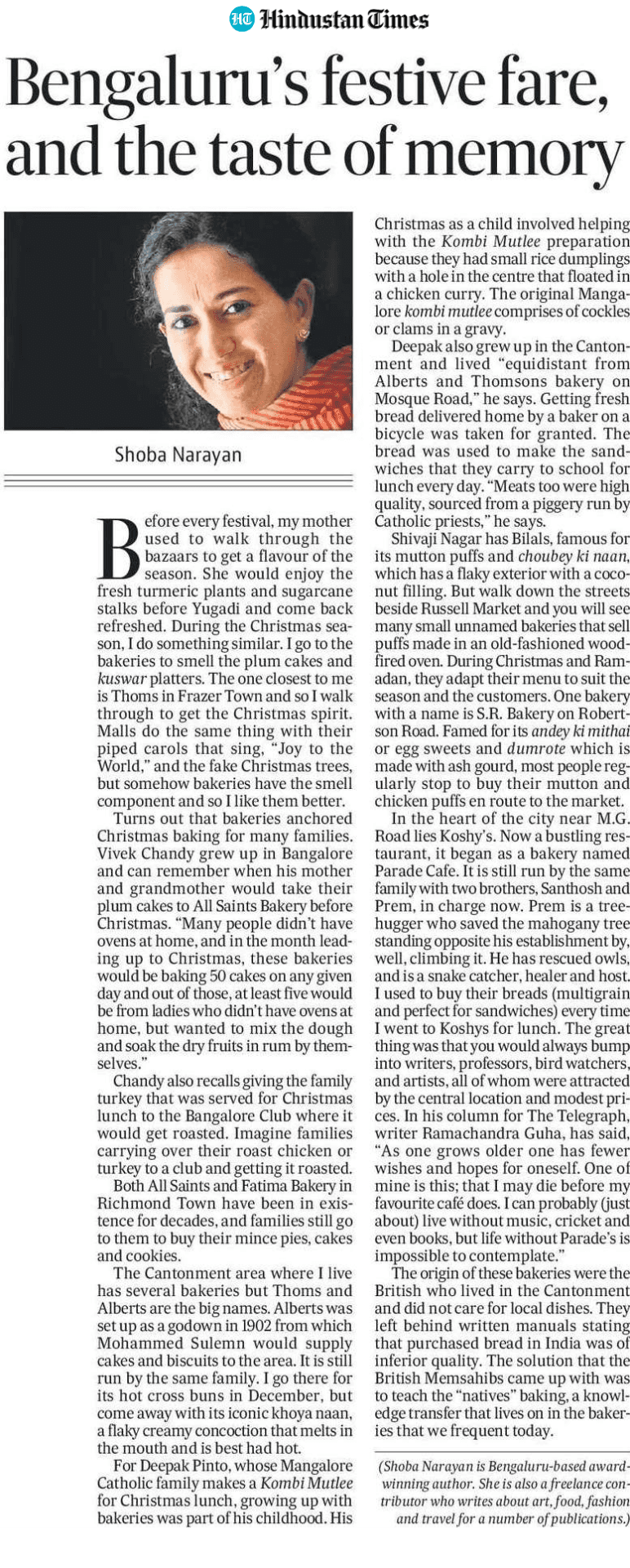
Shoba Narayan is Bangalore-based award-winning author. She is also a freelance contributor who writes about art, food, fashion and travel for a number of publications.



Leave A Comment