
The sound is like a heartbeat; the rhythmic click-clack of looms– seemingly– with no beginning or end, much like the flowing Narmada nearby. I am standing under an ancient neem tree in the center courtyard of the Rehwa Society, thinking back to the women who have brought me here. My mother and aunts of course, who all wore Maheshwaris in tropical Chennai. I wore them too, for special occasions. And although I didn’t know it then, the history of this particular weave, unlike many others in India, is linked to women.
It began with Queen Ahilyabai Holkar who made Maheshwar the capital of her Malwa kingdom in 1767. She invited weavers from Surat, Mandu and even Hyderabad to to create special weaves for her, taking inspiration from the stone sculptures of her fort. The architectural element is obvious in the geometric patterns adorning traditional Maheshwari weaves such as the garbha reshmi (silk of the womb). For centuries, Rani Ahilya’s patronage of this weave held strong. In the early 1900s though, weavers lost sales, abandoned their art and were on the verge of collapse.
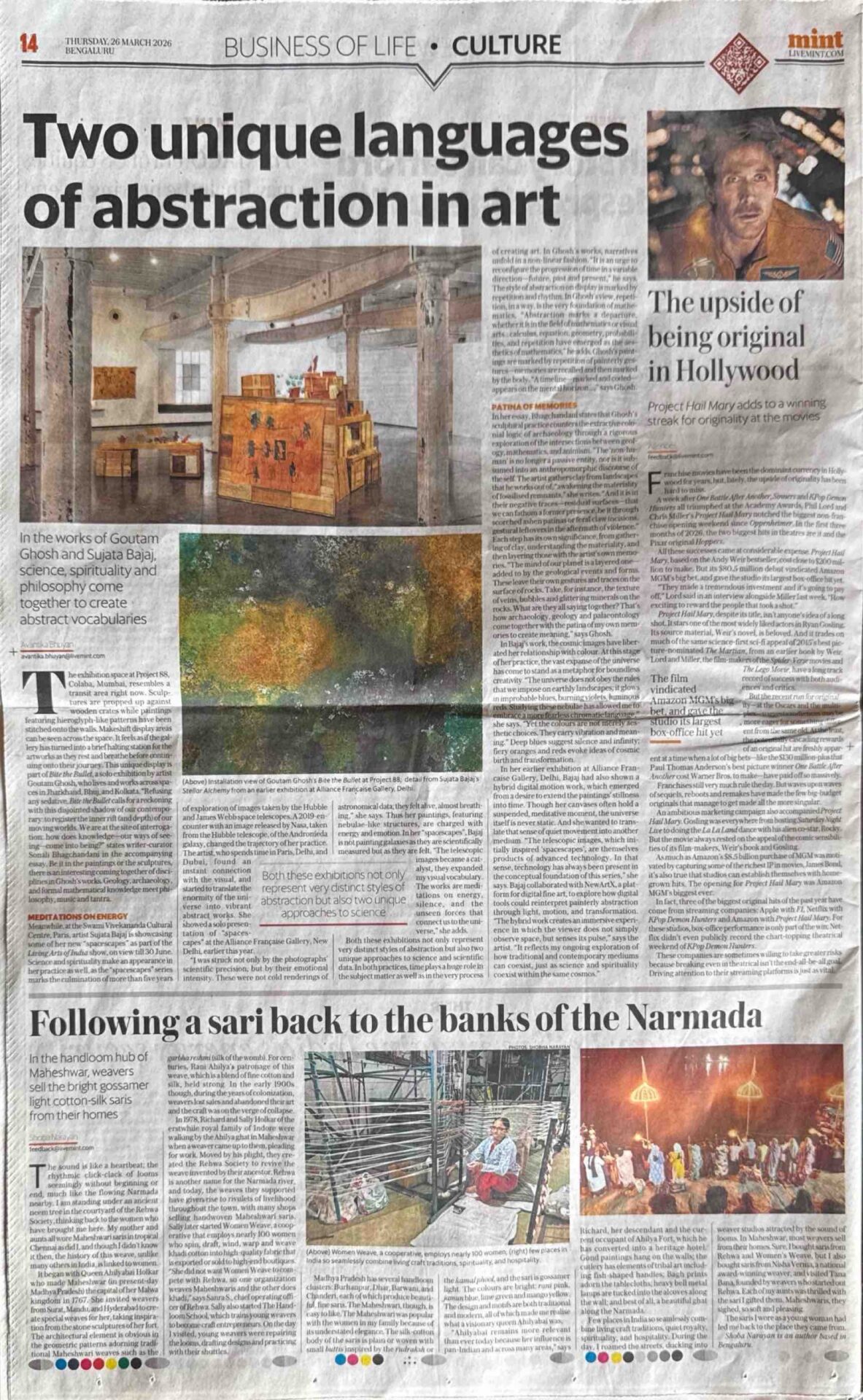
In 1978, Richard and Sally Holkar, then married, were walking by the Ahilya ghat when a weaver came up to them, pleading for work. Moved by his plight, they created the Rehwa Society to revive the weave invented by his ancestor. Rehwa is another name for the Narmada river. Today, the river weaves they supported have fostered many rivulets all through town, with shops proclaiming handwoven Maheshwari sarees. Sally later started “Women Weave,” a cooperative that employs nearly 100 women who spin, draft, wind, warp and weave khadi cotton into high-quality fabric that is exported or sold to high-end boutiques. “She did not want Women Weave to compete with Rehwa, so one organization weaves Maheshwaris and the other does khadi,” says Sanra S, chief operating officer of Rehwa. Sally, who was awarded a Padma Shri, also started The Handloom School, which trains young weavers to become craft entrepreneurs. On the day I visited, young weavers were repairing the looms, drafting designs and practicing with their shuttles.
Madhya Pradesh has several handloom clusters: in Burhanpur, Dhar, Barwani, and Chanderi. The Maheshwari, though, is easy to like. My mother, for instance, dismisses many of the Northern weaves such as the Banarasi, Bomkai, and Baluchari as being “too gaudy” and overwrought. To her, plain jewel-toned Kanchipuram sarees with their distinctive korvai border epitomize elegance.
The Maheshwari was popular with her and my aunts because of its “understated elegance.” The body was silk-cotton and largely plain or featured small buttis inspired by the rudraksh or the kamal phool. The colours were bright: rani pink, jamun blue, lime green and mango yellow. But unlike heavy Southern weaves, the Maheshwari was gossamer light. Its design and motifs were both traditional and modern, all of which made me realize what a visionary queen Ahilyabai was.
”Ahilyabai remains more relevant than ever today because her influence is pan-Indian and across many areas,” says Richard Holkar, her descendant and current occupant of the Ahilya Fort, which he has converted into a heritage hotel with distinct character. Gond paintings hang on the wall; the cutlery has elements of tribal art including fish-shaped handles; Bagh prints adorn the tableclothes; and heavy bell metal lamps are tucked into the alcoves along the wall. A cookie-cutter five-star hotel, this is not. Holkar and his son, Yeshwant are expanding their ambit into Ahilya Experiences with a property in Goa. Ahilya Fort however is the original, still relevant like its namesake with perhaps the most beautiful river ghat in the country, according to Royina Grewal’s book on the Narmada: Sacred Virgin.
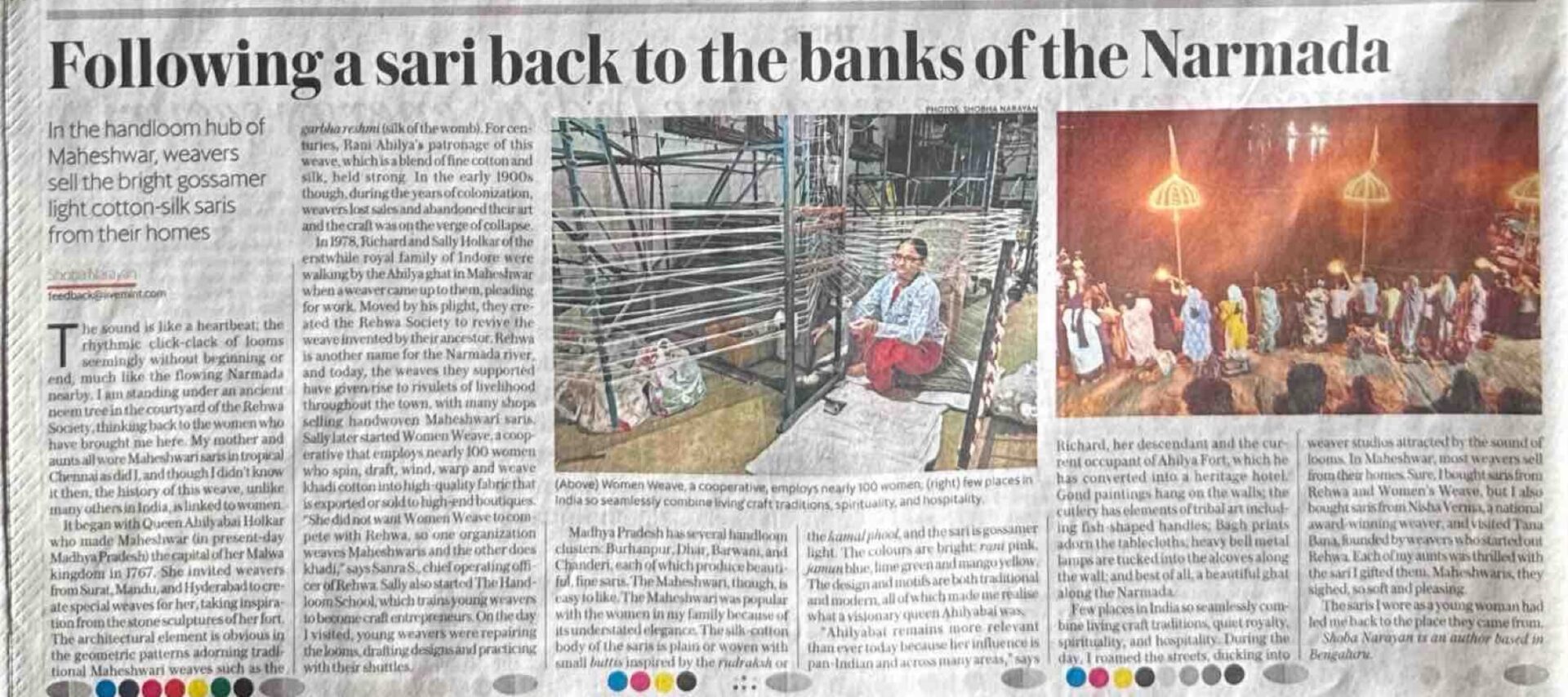
“Narmadey Har,” shout the hundreds of devotees who have gathered on the riverbank for arathi that happens every night from 8 to 9 pm. Three priests hold up fire and incense and circle them around in a choreographed fashion. Their sacred chants are raucously amplified by loudspeakers. The religious fervour and veneration for the river, however, is palpable. The Narmada is in her middle age in Maheshwar and flows with broad self-assurance. Amongst all the rivers of India, she is a virgin, and considered so pure that even the Ganga comes to take a bath in her waters to release all the sins that she has accumulated. Unlike many of India’s storied rivers, she flows west rather than east and empties herself out into the Arabian Sea.
For decades, I have wanted to see the Narmada and visit the land where the Maheshwaris originated. This ancient capital of Avanti has been mentioned in the Ramayana, the Mahabharata, and Buddhist texts as well. Indeed, the Narmada flows over the valley that was created when Gondwanaland crashed into the Indian subcontinent creating the Himalayan range. Today Maheshwar wears it ancient geological origins lightly. Few places in India so seamlessly combine living craft traditions, quiet royalty, spirituality, and hospitality. Richard Holkar is a royal, yes, but he also went to Stanford. He is a curious aesthete and a total character. One morning, I walked up to the breakfast area of Ahilya Fort which overlooks the Narmada and her ghats to find him having an old-fashioned shave in one corner, right in front of the guests. Another day, he had us taste different honeys and ghee he was sourcing to figure out which was the best. The food at Ahilya Fort is simple but delicious. I plan to recreate their heirloom tomato salad, cold beetroot soup and fried eggplant, but I suspect that they won’t be as tasty given I don’t have an in-house organic garden. The orange juice served every morning is the best I have had.
During the day, I roamed the streets, ducking into weaver studios attracted by the sound of looms. Buying handloom clothes these days involves a choice that is not easy to make: you have to pay more. You cannot balk at paying Rs. 5000-10,000 knowing full well that sarees are available for half that. In Maheshwar, this choice was made easier by the fact that most weavers sell out of their homes. Sure, I bought sarees from Rehwa and Women’s Weave, but I also bought sarees from Nisha Verma, a national award winner and visited Tana Bana, founded by people who broke off from Rehwa. Each one of my aunts was thrilled with the saree I gifted them. Maheshwaris, they sighed. So soft and pleasing.
The sarees I wore as a young maiden had led me back to the place they came from.
-k4lD-U204025897261YmH-250x250%40HT-Web.jpg "Shoba Narayan")
Shoba Narayan is Bangalore-based award-winning author. She is also a freelance contributor who writes about art, food, fashion and travel for a number of publications.
https://www.instagram.com/p/DWYoX-dgcJf/?utm_source=ig_web_copy_link&igsh=MzRlODBiNWFlZA==



Leave A Comment