
WE sat around the dining table, my family and I, replete from yet another home-cooked South Indian dinner. It was my younger brother, Shyam, who asked the question.
“Shoba, why don’t you stay back here for a few months? So we can try to get you married.”
Three pairs of eyes stared at me across the expanse of the table. I sighed. Here I was, at the tail end of my vacation after graduate school. I had an Air France ticket to New York from Madras in 10 days. I had accepted a job at an artist’s colony in Johnson, Vt. My car, and most of my possessions, were with friends in Memphis.
“It’s not that simple,” I said. “What about my car . . . ?”
“We could find you someone in America,” my dad replied. “You could go back to the States.”
They had thought it all out. This was a plot. I glared at my parents accusingly.
Oh, another part of me rationalized, why not give this arranged-marriage thing a shot? It wasn’t as if I had a lot to go back to in the States. Besides, I could always get a divorce.
Stupid and dangerous as it seems in retrospect, I went into my marriage at 25 without being in love. Three years later, I find myself relishing my relationship with this brilliant, prickly man who talks about the yield curve and derivatives, who prays when I drive, and who tries valiantly to remember names like Giacometti, Munch, Georgia O’Keeffe and Kandinsky.
My enthusiasm for arranged marriages is that of a recent convert. True, I grew up in India, where arranged marriages are common. My parents’ marriage was arranged, as were those of my aunts, cousins and friends. But I always thought I was different. I blossomed as a foreign fellow in Mount Holyoke where individualism was expected and feminism encouraged. As I experimented with being an American, I bought into the American value system.
I was determined to fall in love and marry someone who was not Indian. Yet, somehow, I could never manage to. Oh, falling in love was easy. Sustaining it was the hard part.
Arranged marriages in India begin with matching the horoscopes of the man and the woman. Astrologers look for balance and cyclicality, so that the woman’s strengths balance the man’s weaknesses and vice versa. Once the horoscopes match, the two families meet and decide whether they are compatible. It is assumed that they are of the same religion, caste and social stratum.
While this eliminates risk and promotes homogeneity, the rationale is that the personalities of the couple provide enough differences for a marriage to thrive. Whether or not this is true, the high statistical success rate of arranged marriages in different cultures — 90 percent in Iran; 95 percent in India, and a similar high percentage among Hasidic Jews in Brooklyn and among Turkish and Afghan Muslims — gives one pause.
Although our families met through a mutual friend, many Indian families meet through advertisements placed in national newspapers.
My parents made a formal visit to my future husband’s house to see whether Ram’s family would treat me well. My mother insists that “you can tell a lot about the family just from the way they serve coffee.” The house had a lovely flower garden. The family liked gardening. Good.
Ram’s mother had worked for the United Nations on women’s-rights issues. She also wrote humorous columns for Indian magazines. She would be supportive. She served strong South Indian coffee in the traditional stainless steel tumblers instead of china; she would be a balancing influence on my youthful radicalism.
Ram’s father had supported his wife’s career even though he belonged to a generation of Indian men who expected their wives to stay home. Ram had a good role model. His sister was a pediatrician in Fort Myers, Fla. Perhaps that meant he was used to strong, achieving women.
Nov. 20, 1992. Someone shouted, “They’re here!” My cousin Sheela gently nudged me out of the bedroom into the living room.
“Why don’t you sit down?” a voice said.
I looked up and saw a square face and smiling eyes anxious to put me at ease. He pointed me to a chair. Somehow I liked that. The guy was sensitive and self-confident.
He looked all right. Could stand to lose a few pounds. I liked the way his lips curved to meet his eyes. Curly hair, commanding voice, unrestrained laugh. To my surprise, the conversation flowed easily. We had a great deal in common, but his profession was very different from mine. I learned that he had an M.B.A. from the University of Michigan and had worked on Wall Street before joining a financial consulting firm.
Two hours later, Ram said: “I’d like to get to know you better. Unfortunately, I have to be back at my job in Connecticut, but I could call you every other day. No strings attached, and both of us can decide where this goes, if anywhere.”
I didn’t dislike him.
HE called 10 days later. We talked about our goals, dreams and anxieties; we argued over which was the best pizza place in New York, and we teased and joked with each other. He never seemed to be in a rush.
“What do you want out of life?” he asked me one day. “Come up with five words, maybe, of what you want to do with your life.” His question intrigued me. “Courage, wisdom, change,” I said, flippantly. “What about you?”
“Curiosity, contribution, balance, family and fun,” he said. In spite of myself, I was impressed.
One month later, he proposed and I accepted. Our extended honeymoon in Connecticut was wonderful. On weekends, we took trips to Mount Holyoke, where I showed him my old art studio, and to Franconia Notch in New Hampshire, where we hiked and camped. We huddled under the covers on rainy summer days and caught up on each other’s lives.
It was in Taos, N.M., that we had our first fight. Ram had arranged for a surprise visit to the children’s summer camp where I used to work as a counselor. We visited my old colleagues with their Greenpeace T-shirts and New Age commune mentality. Ram, with his clipped accent, neatly pressed clothes and pleasant manners, was so different. What was I doing with this guy? On the car trip to the airport, I was silent. “I think, perhaps, we might have made a mistake,” I said slowly. The air changed.
“Your friends may be idealistic, but they are escaping their lives, as are you,” he said. “We are married. Accept it. Grow up!”
He had never spoken to me this harshly before, and it hurt. I didn’t talk to him during the entire trip back to New York.
That fight set the pattern of our lives for the next several months. In the evening, when Ram came home, I would ignore him or blame him for bringing me to Connecticut. Half-heartedly, I searched for a job and mutely handed him the rejection letters. He would hold me, whispering soothing words, but I was too depressed to care about it. Or him.
Two years into our marriage, something happened. I was ashamed to realize that while I had treated Ram with veiled dislike, he had always tried to improve our relationship. I was admitted to the journalism program at Columbia, where, at Ram’s insistence, I had applied.
Falling in love, for me, began with small changes. I found myself relishing a South Indian dish that I disliked, mostly because I knew how much he loved it. I realized that the first thing I wanted to do when I heard some good news was to share it with him. Somewhere along the way, the “I love you, too” that I had politely parroted in response to his endearments had become sincere.
My friends are appalled that I let my parents decide my life partner; yet, the older they get the more intriqued they are. I am convinced that our successful relationship has to do with two words: tolerance and trust. In a country that emphasizes individual choice, arranged marriages require a familial web for them to work. For many Americans that web doesn’t exist. As my friend Karen said, “How can I get my parents to pick out my spouse when they don’t even talk to each other?”
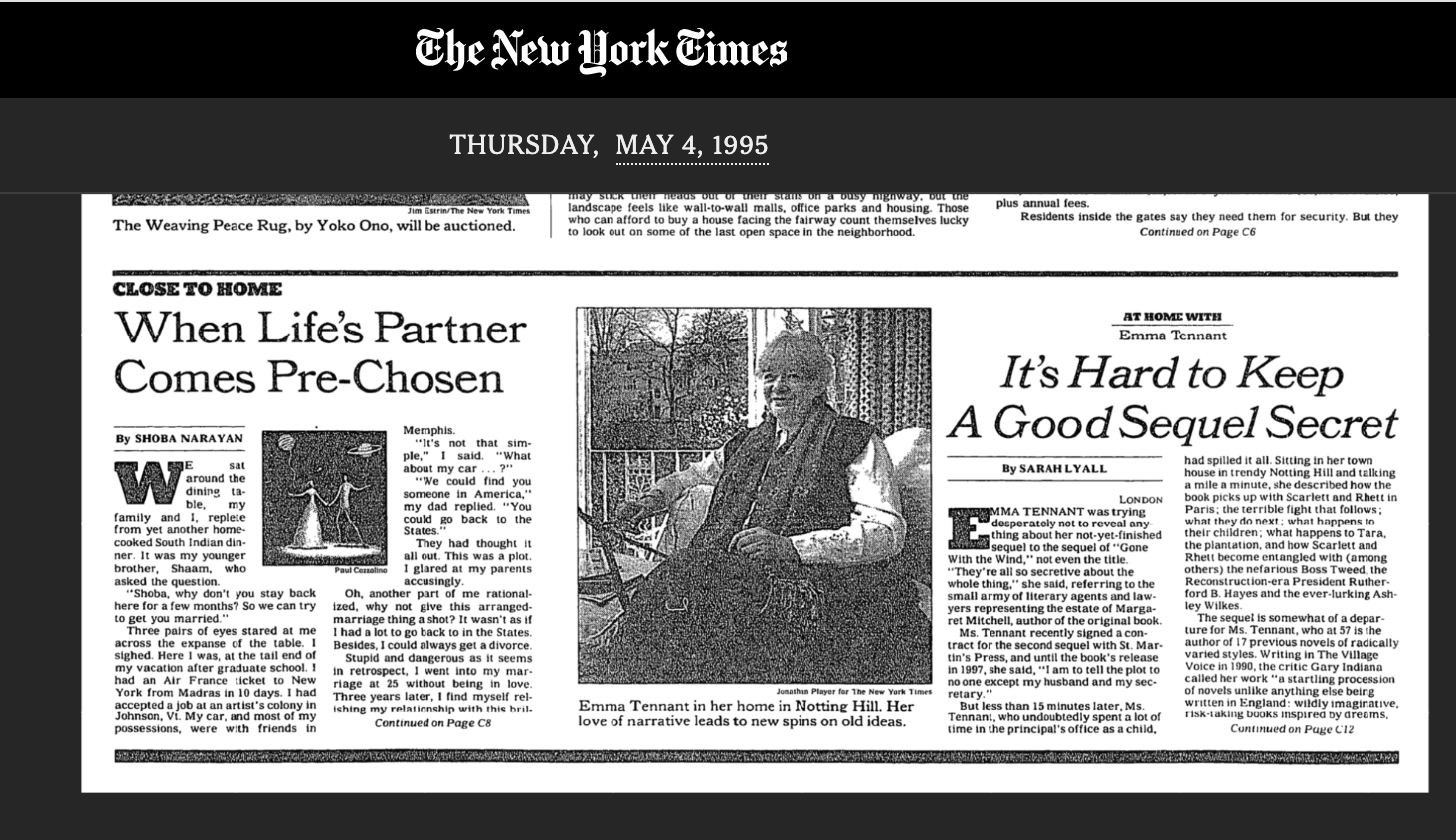
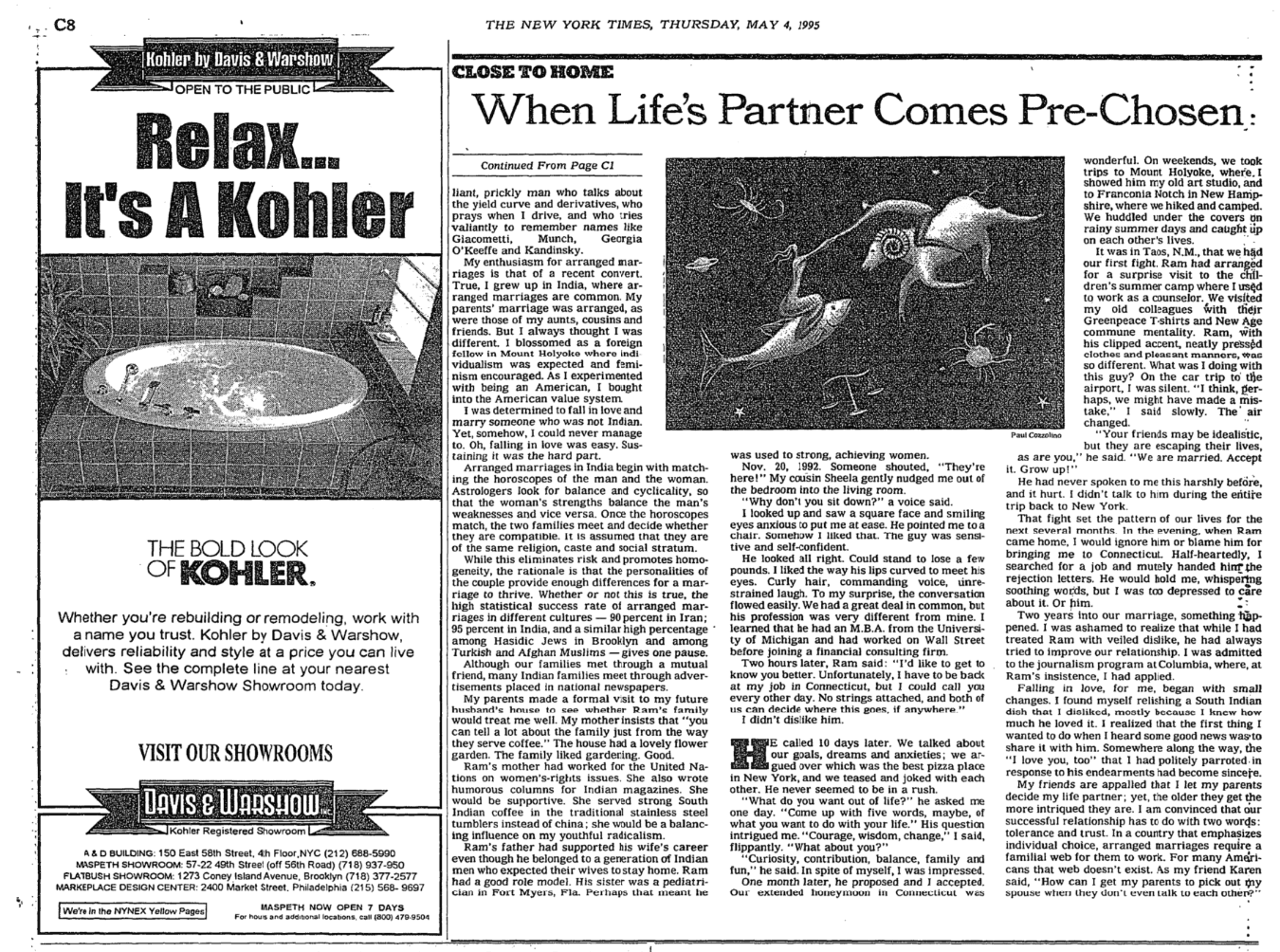
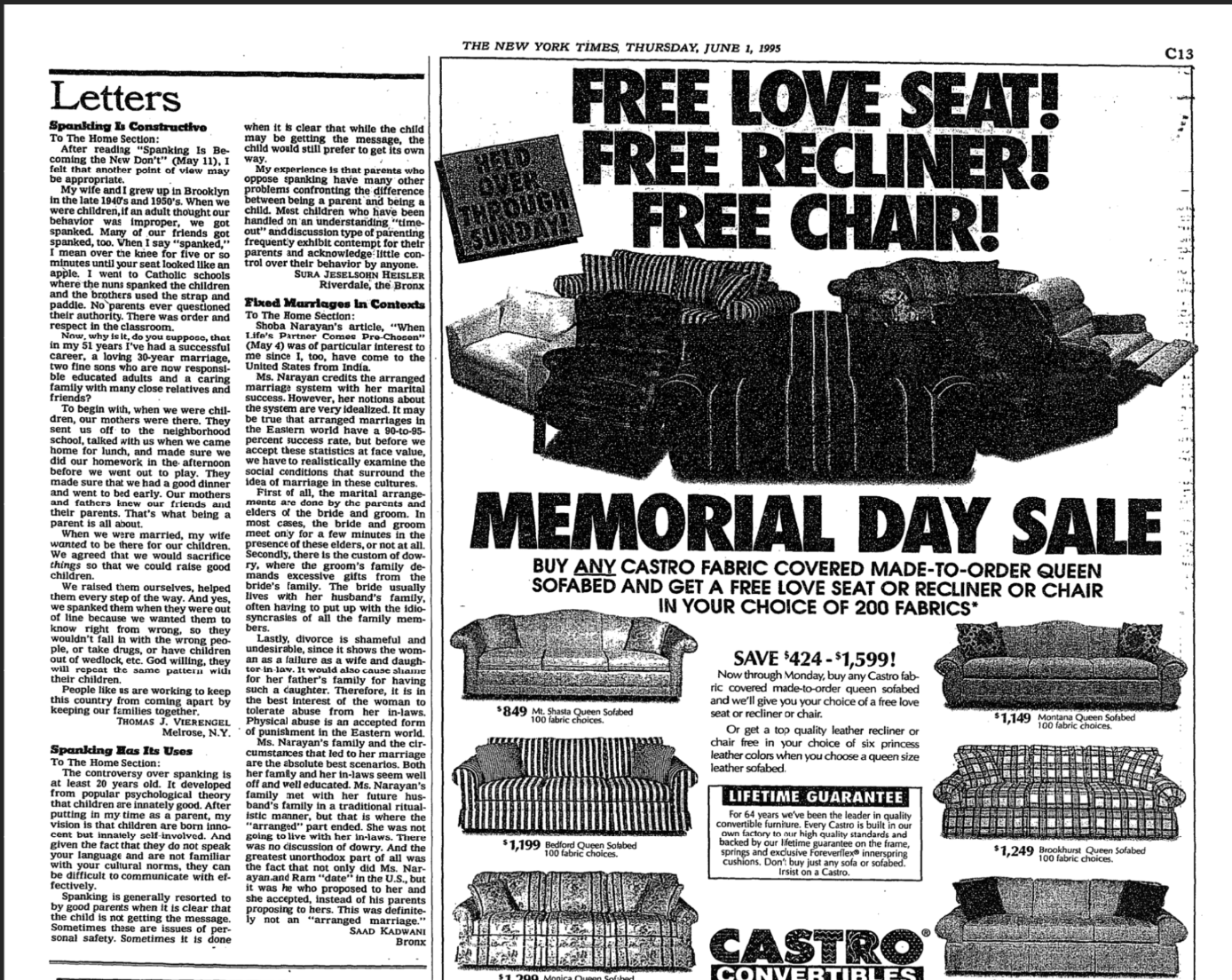
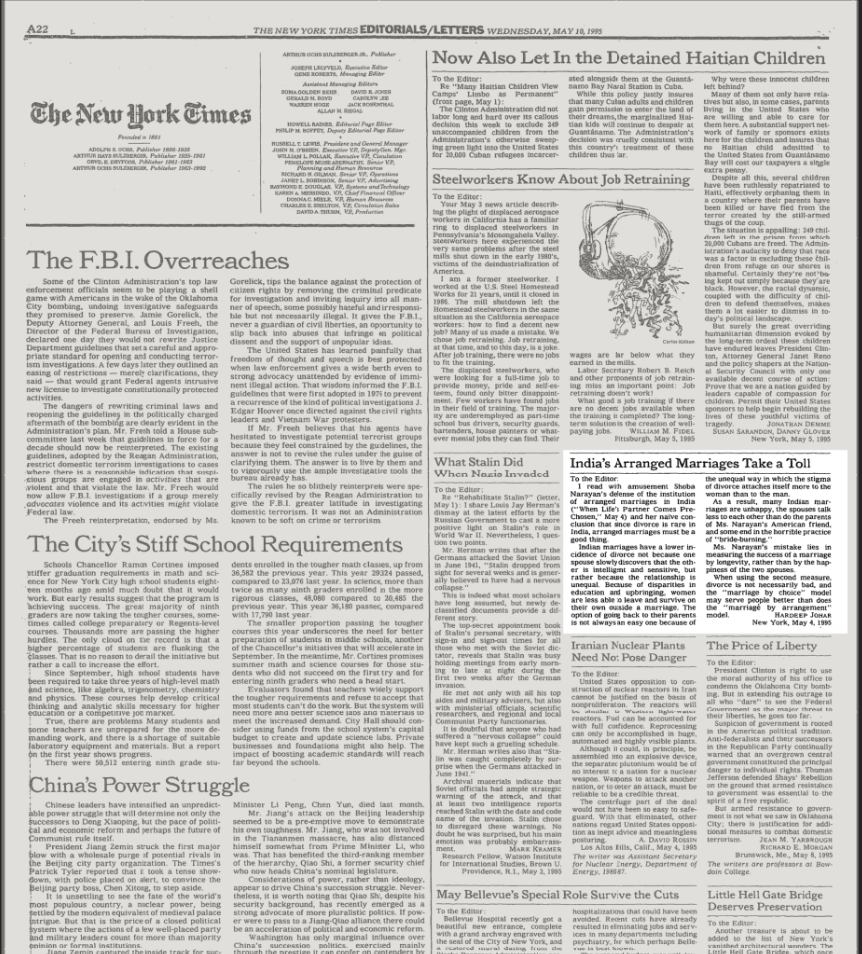
This is the first article that I wrote for the New York Times. I didn’t realize it was available on the Times’ digital archives till someone forwarded it to me. I was a student at Columbia University J-school at this time. Married, living in Stamford, CT and commuting to the city everyday. I was in my kitchen in Stamford one weekend when I got a call from a women who identified herself at the NYT Home section editor. She wanted me to write an article. We brainstormed for ideas and came up with this piece.



Leave A Comment