
If you ask Bangalore chefs where they go to get a taste of Karnataka, they will likely point to one of the Khanavalis. These are traditional family-run “messes” found in the industrial and residential heartlands of Vijayanagara or Rajajinagara (the northern pronunciation typically takes out the “a” at the end of these names but I have retained the Karnataka version of saying these words). When you enter a Khanavali, you leave the Garden City behind and enter the simple heartland of the Deccan.
This is tasty, healthy food served generously and without fuss, all anchored by jowar and bajra rottis. I once went backstage at a Khanavali to see how the soft and thin jolada rottis are prepared. Made with gluten-free sorghum flour, this flat bread cannot be rolled out with a rolling pin. Instead a group of women sits around a stainless steel table and pats it into shape in what Jyotsna Kamat calls an “anapaestic rhythm.”
Later this rotti is placed on an open fire until it puffs up and develops the pizza-like leopard spots where it is charred. It is the ultimate slow-release carbohydrate designed for an agrarian life where people need to survive 10 hours under a relentless sun. While the jolada roti may be the star of the show, it is accompanied by its heroine, the ennegayi. These purple baby brinjals are slit and stuffed with a potent paste of roasted peanuts, spices, and onion, which are then slow-cooked in a generous amount of oil (enne means oil). The result is a rich gravy where the nuttiness of the peanuts balances the slight bitterness of the brinjal.
What makes this cuisine distinct and the reason we call it a dry cuisine is the powders. The trio of powders includes Shenga or peanut powder, which is not just a snack but a religion in Upper Karnataka. Then there is the Gurellu powder made with Niger seeds. It is pungent, earthy, and slightly bitter, giving the curries a depth unique to this region. The last of the trio is the Agasi Bija or the flax seed, which is a nutritional powerhouse used in Upper Karnataka long before it became a superfood in the West.
One of the most efficient ways to eat the Agassi or flax seeds it is through a pickle recipe called Karindi, which is also made in Uttara Karnataka.
The elegant simplicity of this recipe complements the nutritional punch that it carries. A karindi comprises three things. Hand pounded flax seeds mixed with a little mustard seeds. This powder is then mixed with hand pounded green chillies, coconut and garlic. The entire concoction is then mixed with raw carrots, cucumbers, peanuts and black chana dal. All of this is mixed together, placed in an earthen bowl, covered with cloth and set under the sun for about three days. This allows the ingredients to mix together and ferment. The result is a warm, pungent, and salty pickle eaten with jolada roti.
The advantage of this karindi is that it also improves the health benefit. One of the problems with flaxseeds is the presence of cyanogenic glycosides (CGs), which, nutritional papers say, “severely limits the exploitation of its health benefits and nutritive value.” Leaving it under the sun helps evaporate the CGs and improves the nutritional value.
The final aria to this symphony is the raw onion and green chilli. You are expected to smash the onion with your fist and eat it alongside the roti. It is pungent, tear-inducing, and considered essential for digestion particularly if you chew off a piece of raw green chili, which will instantly cool down your body and make your eyes water.
The sweet complement to all this is the junka or junaka, a dense fudge made from besan or gram flour, which is the Uttara Karnataka answer to a quick protein fix.
The modern purveyor of this food is a restaurant chain called Basaveshwara Khanavali with branches in St. Mark’s Road, Jayanagar, and other parts of the city. Family run (it is owned by the Ganachari family) and founded in Dharwad, it is at its Koramangala outlet that I had one of my most memorable meals in Bangalore.
In Bangalore the Khanavali culture led by restaurant chains such as Nalapaka, Kamat and Basaveshwara, offer a taste of home to professionals from Kitturu, Belagavi, Kalaburgi and other parts of the Upper Deccan. To folks from Uttara Karnataka, a jolada rotti is a taste of home.
It is also a reminder that Karnataka is not just a land of filter coffee, Mysore silk and soft idli-dosa. It is also a land of sorghum, spicy powders, fermented pickles and stuffed brinjals that represent the enduring resilience of the Deccan plateau.
-k4lD-U204025897261YmH-250x250%40HT-Web.jpg "Shoba Narayan")
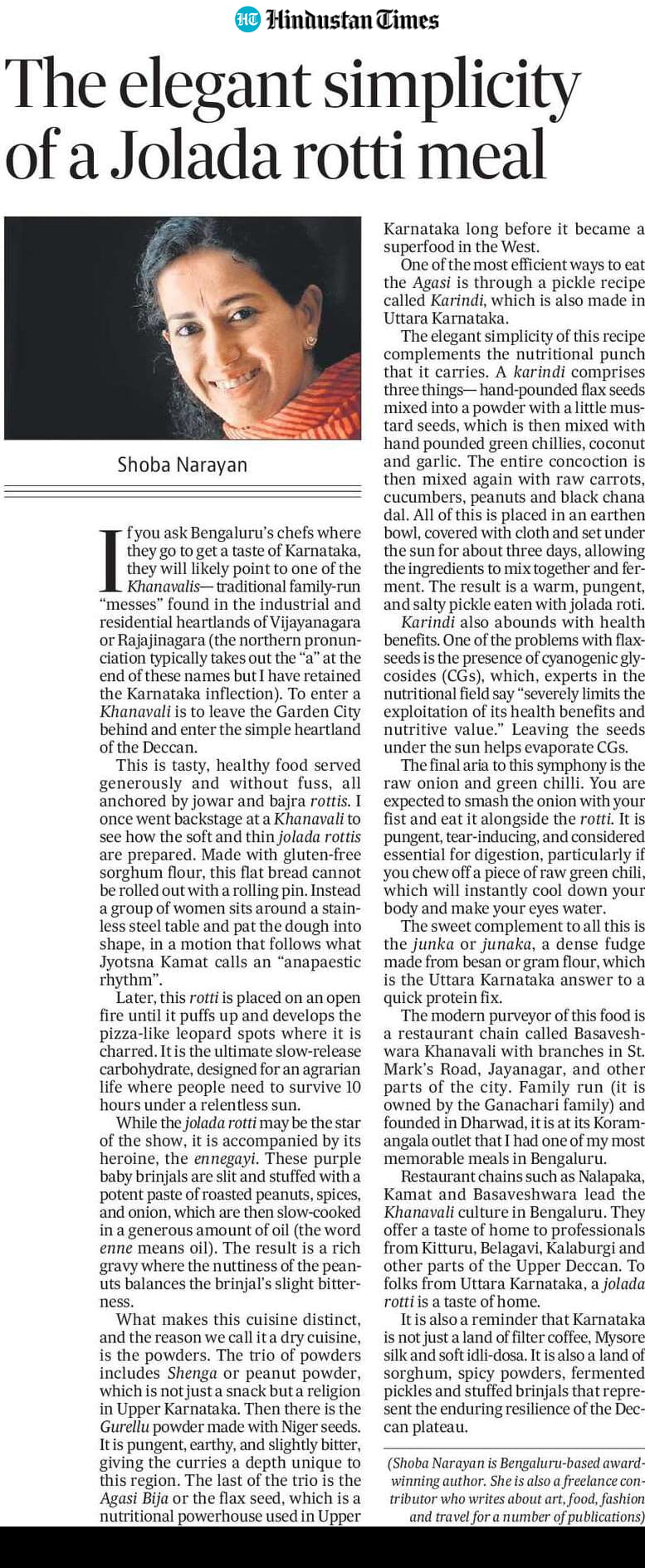
Shoba Narayan is Bangalore-based award-winning author. She is also a freelance contributor who writes about art, food, fashion and travel for a number of publications.





Leave A Comment