
Which is the real Iyengar bakery? I thought about this as I bit into a Dil Pasand, which along with Congress buns and khara (savoury) biscuits is an iconic food item made at what are called Iyengar bakeries in Bangalore. Within a 2 kilometre radius from my home, there are 12 such bakeries. In Bangalore, there are over 500 Iyengar bakeries. And therein lies my question: if there are so many Iyengar bakeries, how to spot the authentic ones?
A hilarious thread on Reddit had the same thought. Titled “Which one is the true fckin’ Iyengar’s bakery?” it was a rant against the many pretenders holding this brand name and selling egg puffs. So which is the true Iyengar bakery, began the thread. The answers came fast and hilarious. That’s like asking, which is the original Balaji Wines, or Durga Medicals, Ganesh Fruit Juice, Parameshwari Traders, Akbar Travels, Bangarapet Chaats, Basveshwara Khanavali, SLV Tiffin Room, Udupi Lunch Home, Vasavi Condiments, or cab drivers called Manjunath, and bus drivers called Basavaraju. Before we had franchises that sanitized and equalized everything we eat and drink, ranging from coffee to croissants, there were unique and distinct stores started and run by families. You could argue that Iyengar bakeries were the first franchise. Perhaps it started with different family members before branching out to become a brand name.
What makes these bakeries special is the way they combine ingredients. Take this Dil Pasand for instance. It has tutti-frutti, used in Christmas cakes; includes generous portions of grated coconut, which is a staple of South Indian sweets; folds all these ingredients into a buttery flat-bread, reminiscent of the samosa, which originated in Persia. So it is like a Hindu-Christian-Muslim combo. Rather than frying it like most Indian sweets, this one is baked, a western innovation learned by one Mr. H.S.Tirumalachar, from a British officer in 1898. Originally from Hassan, the original Iyengar opened his bakery under the moniker, Bangalore Brothers (BB) Bakery in Avenue Road. Since then, Iyengar bakeries have percolated every part of the city and country.
But here’s a question: When was the last time you ate at an Iyengar bakery? In the nineties, before fancy West-inspired bakeries like Lavonne showed up, most Bangaloreans queued up to buy honey cakes, khara biscuits, vegetable puffs and milk bread from Iyengar bakeries. These days though, most urban Indians have switched to sourdough breads and croissants. I haven’t gone to an Iyengar bakery in a while. I like Albert Bakery in Frazer town, but I go for the Khoya buns. The Iyengar bakery items add too much coconut and sweets.
The time I visit an Iyengar bakery is when I am racked with nostalgia for “home.” Then, I stand in line and buy vegetable puffs at my local bakery. The ability to combine the savoury with the sweet is unique to India. Sure, you have the spanakopita from Greece in which a spinach filling is stuffed into a puff pastry, but it doesn’t have the spicy bite that our puffs have. Iyengar bakeries take this to the next level. It’s not just savoury things that we stuff inside our puffs. The vegetable puff, for example, is a perfect accompaniment to afternoon chai, but we do this with our humble buns as well. The vada pav of Maharashtra is of course the most iconic example of a hearty savoury disc-shaped spicy patty laden with more spicy green and red chutneys, all snuggled into a bun. The Iyengar bakery version includes many things such as the Congress kadlekai.
The reason a dish becomes linked to a place is because of an ingredient, like Davanagere benne dose or Mysore masala dose, or Coorg coffee. Hassan was the birthplace of the Iyengar bakeries because the first Iyengar to start the bakery came from Hassan. In India, we still maintain links with the land that we hail from even if we move away. So to this day, there are bakeries in Bangalore named Hassan Iyengar Bakery as an illusion to the land where they originated.
What is the future of these bakeries? At a time when the young Indian, who has grown up on puffs and cakes from such homestyle bakeries, wants to separate from such an umbilical cord and eat donuts costing ₹400 each, how can these bakeries that are typical and emblematic of India maintain their demand and customer base? Loyalty and nostalgia will only get you so far after all. Should you innovate if you are an Iyengar bakery or should you stay true to your roots? In such a situation, I would choose the latter. In a landscape where food is continuously being changed, fused with other cuisines and innovated, sometimes repetition and consistency without alteration is itself a radical stand. In doing this, you could argue that the Iyengar bakeries have become beacons of hope but also clarity.
-k4lD-U204025897261YmH-250x250%40HT-Web.jpg "Shoba Narayan")
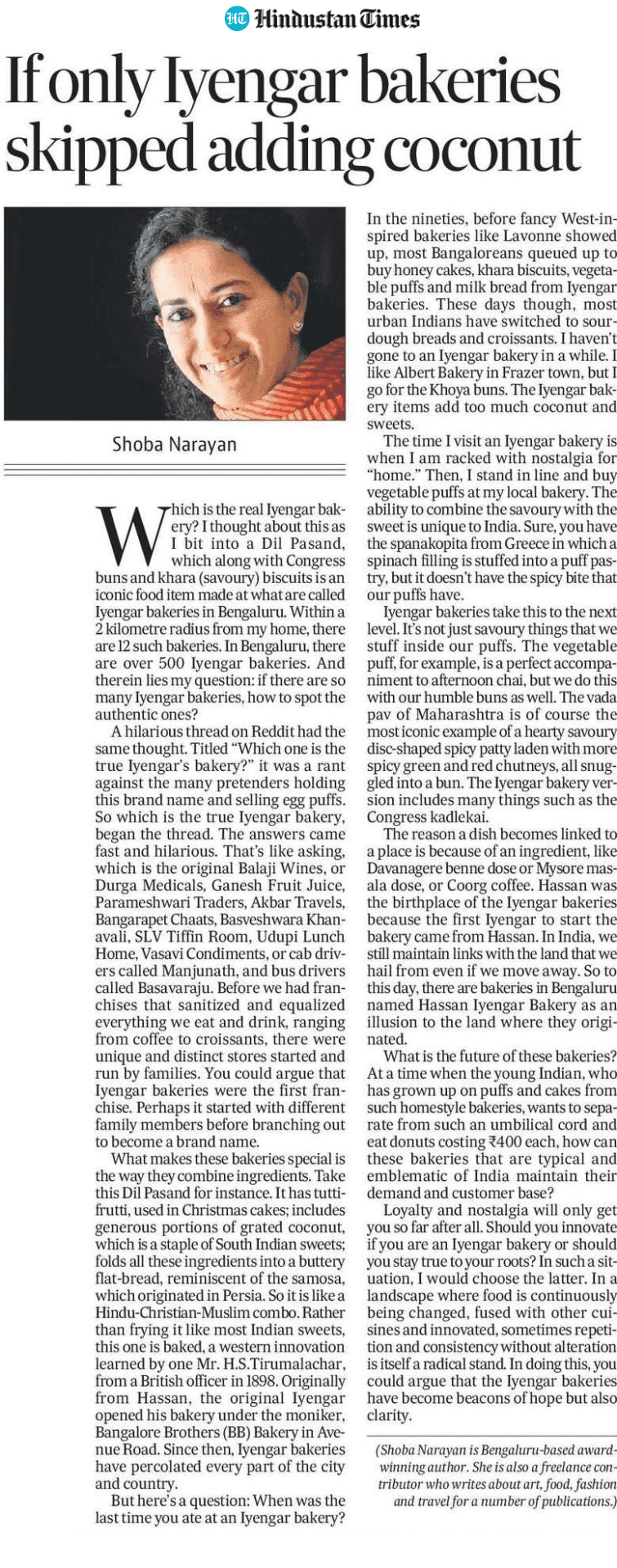
Shoba Narayan is Bangalore-based award-winning author. She is also a freelance contributor who writes about art, food, fashion and travel for a number of publications.



Very interesting read!